Looking to find a secure and reliable method of working with data in the age when cyberattacks and regulatory obligations keep expanding? Secure database management platforms have emerged as a necessity to contemporary digital systems, assisting organizations in storing, managing, and protecting valuable information with confidence. The requirement of robust and secure databases has never been greater than at present, as startups handling customer records and enterprises managing large transactional workloads alike face growing risks.
Contemporary database systems do not simply focus on storage. They integrate sophisticated security protocols, encryption, access control, high availability, and scalability to keep data secure, accessible, and compliant across environments. Whether implemented on-premise, in the cloud, or within a hybrid setup, choosing the right secure database solution can significantly impact performance, trust, and business continuity.
What Are Database Management Tools?
Database management tools refer to computer programs that can assist organizations to design, store, manage, secure and maintain databases effectively. They also include interfaces and automation of data modeling, querying, indexing, backup, recovery, performance optimization and access control by users.
Such tools enable administrators and developers to process vast amounts of structured or unstructured data but maintain integrity, availability and security. Monitoring, auditing, encryption, and compliance features are also available in modern platforms and minimize operational risks.
Database management tools offered as on-premise, cloud-based, or a hybrid deployment make life easier in managing databases, boosting performance, and allowing the businesses to expand data operations on a reliable basis. They help in analytics, application development, and decision-making among the global teams and different environments.
Benefits of Secure Database Management Platforms
Below are the benefits of database management platforms:
1. Strong Data Protection
These platforms have encryption, access control and auditing features that ensure unauthorized access and protection of important business and customer information.
2. Enhanced Readiness in compliance
The regulatory needs of GDPR, HIPAA, PCI-DSS, industry-specific standards are supported by inbuilt governance and reporting facilities with secure databases.
3. Lessened Cyberattack threat
Higher-level vulnerabilities detection, authentication and monitoring of the activities are used to minimize the vulnerabilities and minimize the effects of attacks.
4. High Availability and Disaster Recovery
The majority of current systems have replication, automatic failure, and backup to maintain the uptime and quick recovery in case of failure.
5. Scalable Performance
Secured database system is able to scale with business expansion and serves the rising workload of cloud and hybrid system and distributed systems.
How to Choose a Secure Database Management Platform?
The choice of the appropriate secure database management system is determined by the data requirements, infrastructure and compliance requirements of your organization. There are so many power-packed alternatives that with the help of the right criteria, you can be able to choose the best option.
1. Evaluate Security Features
Find such necessary defenses as encryption at rest and in transit, role-based access control, auditing, and multifactor authentication. Regulated industries should be on the platforms that have inbuilt compliance support.
2. Take Into Consideration Deployment Requirements
Choose between on-premise database, a cloud-managed system or hybrid. Cloud services such as Amazon Aurora are easy to maintain but on-premises tools are more controllable.
3. Select The Database Type
Relational databases such as Oracle and SQL Server are more effective in transactional load whereas document databases such as MongoDB are more effective in flexible, JSON based apps.
4. Scalability and Availability of Checks
When your company is distributed around the world or your business is likely to grow very quickly, you should use platforms that have distributed architecture, automatic replication, and failover like CockroachDB or YugabyteDB.
5. Look through Compliance, Industry Fit
Financial, healthcare, or government organizations ought to focus on the platforms that have high compliance certifications and enterprise level governance tools.
6. Assess Cost and Licensing
Free databases such as postgresql are cheaper to license, whereas an enterprise database can offer more advanced support and security, at a higher price.
List of 12 Best Secure Database Management Platforms
1. IBM Db2
Website: https://www.ibm.com/products/db2
IBM Db2 is a platform of enterprise relational databases that is designed to handle transaction processing and analytics workloads with security. It involves storage encryption and data in motion encryption using SSL/TLS and workload isolation and monitoring.
Db2 has fine-grained authorization and authoritative controls of users and applications. Its on-premise and cloud versions provide easy deployments, continuous updates, and backup and granite recovery.
IBM Db2 maintains good performance, scalability and security in the hybrid environment avoiding the mistrust of the financial institutions and regulated industries.
Key Features:
- End-to-end encryption
- Monitoring of database activities.
- Advanced access controls
- AI-driven optimization
- Secure hybrid cloud support
- Compliance-ready tooling
Pros:
- Enterprise reliability
- Powerful analytics implementation.
- High security standards
- Hybrid cloud capable
- Trusted in finance
Cons:
- Steep learning curve
- Higher operational cost
- An even smaller developer ecosystem.
Pricing:
- Request pricing
2. Amazon Aurora
Website: https://aws.amazon.com/rds/aurora/
Amazon Aurora is an AWS cloud-based, fully managed relational database service, which is compatible with MySQL and PostgreSQL, making it one of the most reliable secure database management platforms for modern cloud applications. It has automatic backups, multizone replications, and encryption at rest and in transit using AWS Key Management Service (KMS).
The distributed architecture of Aurora enhances resilience and across-the-board availability, and centralized authentication and access can be achieved by integrating into AWS Identity and Access Management (IAM).
Aurora is an automated, online database patching system, and it is easy to deploy automated monitoring to workload database systems. It suits well in the case of scaling cloud applications that need good performance, reliability, and compliance.
Key Features:
- AWS KMS-based encryption
- Multi-AZ replication
- IAM authentication
- Automatic patches and backups.
- MySQL/PostgreSQL compatibility
- Continuous monitoring
Pros:
- Database service fully managed.
- High availability built-in
- Integrated AWS at a deep level.
- Auto scaling capabilities
- Reduced admin workload
Cons:
- AWS-exclusive platform
- Costs grow at scale
- Minimal low level customization.
Pricing:
- Aurora Standard storage: $0.10 per GB-month
- Aurora I/O-Optimized storage: $0.225 per GB-month
3. CockroachDB
Website: https://www.cockroachlabs.com/
CockroachDB is a distributed SQL built-in cloud-native database that has been developed to be resilient and available across regions and data centres.
It is ACID-compatible and PostgreSQL-suitable, so that familiar workflows are supported. Information is automatically copied between nodes, and therefore, it is consistent and fault-tolerant even in case of infrastructure failures.
CockroachDB uses TLS encryption to ensure communication security and allows enterprise authentication. It provides self-healing design and can survive outage, which is why it is suitable for mission-critical systems that need constant availability, high consistency, and high-availability.
Key Features:
- Distributed SQL design
- Automatic replication
- TLS-secured connections
- ACID transaction support
- PostgreSQL compatibility
- Self-healing infrastructure
Pros:
- Architecture that is extremely robust.
- Supports global-scale apps
- Competency consistency ensures.
- Cloud-native by design
- Minimal downtime
Cons:
- Complex operational model
- Some queries have increased latencies.
- Enterprise plans are needed to have advanced features.
Pricing:
- Standard: $0.18/hr
- Advanced: $0.60/hr
4. Oracle Database
Website: https://www.oracle.com/database/
Oracle Database is a commercial relational database system that is enterprise-based and is known as one of the leading secure database management platforms, characterized by scalability, reliability, and extensive security. It promotes fine-grained access control, multifactor authentication, privilege analysis, network encryption (TLS), and integrated auditing to protect sensitive information.
Virtual Private Database, Real Application Security, and features like these implement least-privilege access and segregated policies. Oracle also integrates with enterprise identity services for authentication and provides encryption for both stored and transmitted data.
It is commonly used in the financial, healthcare, and government sectors, where compliance and security are paramount. In conjunction with high-availability tools such as Real Application Clusters, Oracle is capable of managing heavy workloads.
Key Features:
- At rest and in transit encryption.
- VPD Fines grained control.
- Consolidated auditing and monitoring.
- High availability support RAC.
- Multitenant architecture
- Security tools based on compliance.
Pros:
- Vigorous company-level security.
- Very much scalable and dependable.
- Effective regulatory compliance.
- Mature ecosystem
- Trusted across industries
Cons:
- Expensive licensing
- Complex administration
- Risk of vendor dependency
Pricing:
- VM instance (4 vCPUs, 16 GB RAM/month): $54
- Kubernetes cluster (64 vCPUs, 512 GB RAM/month): $3,507
- Block storage (1 TB/month): $43
- Public bandwidth (50 TB/month): $340
5. Microsoft SQL Server
Website: https://www.microsoft.com/en-in/sql-server/
Microsoft SQL Server is a robust, secure enterprise relational database that is used with application workloads of the present day. It features standard security measures like Encryption of Data in Transparency. (TDE), data-in-use Transparent Always Encrypted and sensitive query results masking.
SQL Server has role-based access controls, and its authentication is enhanced by integrating with Active Directory and Kerberos. It has a security dashboard which provides threat information, compliance reports and real-time monitoring.
SQL Server is used extensively on-premise and as a part of cloud deployment decisions and is still a reliable option among enterprises operating with the Microsoft ecosystem.
Key Features:
- Transparent Data Encryption
- Always Encrypted support
- Role-based access control
- Threat detection features
- Compliance tools and Auditing.
Pros:
- Good support for the Windows ecosystem.
- Necessary default settings.
- Easy-to-use management tools
- Excellent OLTP performance
- Broad enterprise adoption
Cons:
- Licensing can be costly
- Less platform-flexibility.
- At a large scale, resource-intensive.
Pricing:
- Enterprise: $15,123
- Standard per core: $3,945
- Standard server: $989
- CAL: $230
Suggested Read: AI Tools for Marketing
6. PostgreSQL
Website: https://www.postgresql.org/
PostgreSQL is an effective open-source relational database that is integrity-driven, extensible, and highly secure, making it one of the most trusted secure database management platforms. It provides role-based access controls with column-level fine-grained access permissions.
PostgreSQL is capable of using SCRAM-SHA-256, Kerberos, GSSAPI, or SSPI to perform secure authentication. Through its SECURITY LABEL option, it supports mandatory access control policies, commonly used with SELinux.
It also offers secure connections using SSL/TLS encryption, allowing administrators to enforce encryption for sensitive workloads. PostgreSQL is popular among mission-critical systems that require consistency, reliability, and deep customization.
Key Features:
- Column level and role-based security.
- Encrypted communication by means of SSL/TLS.
- Higher order authentication techniques.
- Dynamically expandable security extensions.
- ACID-compliant transactions
- Effective integrity implementation.
Pros:
- Completely open-source
- Secure and highly stable
- Extremely extensible
- Strong community support
- No licensing cost
Cons:
- Needs tuning for large scale
- Limited built-in UI tools
- Nonnative enterprise support.
Pricing:
- Open source
7. Cemetech MongoDB Enterprise / MongoDB Atlas.
Website: https://www.mongodb.com/
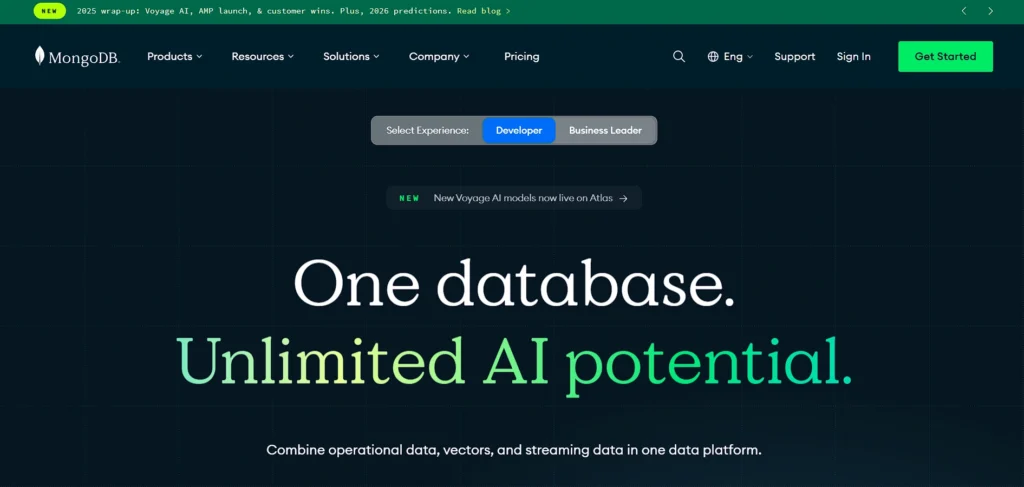
Mongodb Atlas and MongoDB Enterprise are document-oriented databases that are designed to be scaled and ensure the safety of the data. They embrace role based access control and LDAP authentication, Kerberos integration and auditing.
The MongoDB Enterprise advanced has a field-level encryption that secures sensitive document fields across all their life cycles. Atlas also includes the addition of VPC peering, TLS transit and encryption at rest using customer-managed keys.
Fine-grained authorization means that users and applications pass through with necessary permissions only. MongoDB is suited towards contemporary cloud applications based on JSON-oriented schemas and releases that are distributed.
Key Features:
- Field-level encryption
- Role-based permissions
- LDAP and Kerberos support
- Compliance reporting and auditing.
- TLS encryption
- Security controls in the cloud.
Pros:
- Flexible document model
- Strong cloud security tools
- Easy horizontal scaling
- Availability of managed services.
- Developer-friendly experience
Cons:
- Licensing limitations
- High memory usage
- Complex large scale transactions.
Pricing:
- free: $0
- Dedicated: $0.08/hour and $56.94/ month
- Flex: $0.011/hour and $30/ month
8. YugabyteDB
Website: https://www.yugabyte.com/
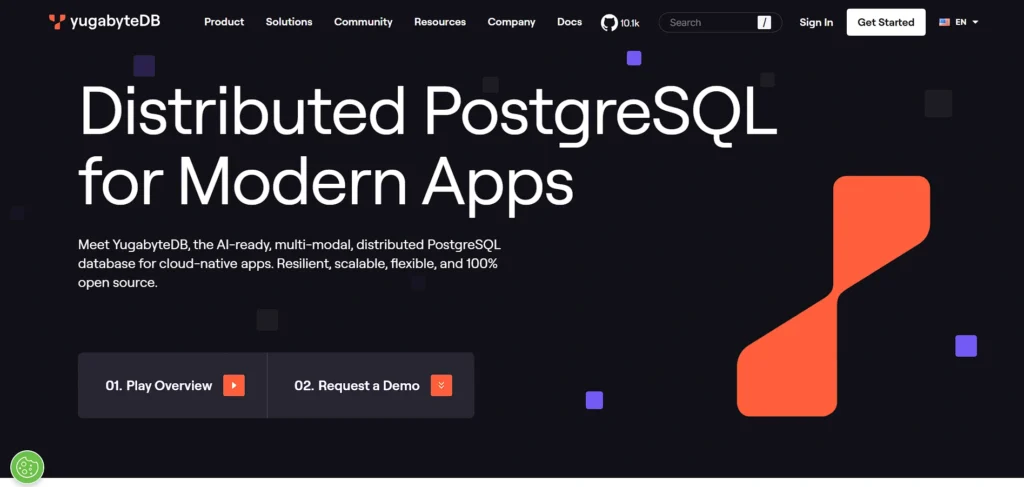
YugabyteDB is a high-performance transactional distributed SQL database that is designed to meet the needs of cloud-native applications and is recognized among secure database management platforms for modern enterprises. It offers ACID compliance, geo-distributed replication, as well as strong consistency across clusters.
YugabyteDB is PostgreSQL compatible and can be readily integrated with existing PostgreSQL tools and applications. It has a partitioned architecture that enhances resilience and fault tolerance, minimizing single points of failure.
Role-based access controls as well as TLS-secured communication are provided in enterprise editions. YugabyteDB is well-suited for global distributed applications where scalability, reliability, and secure operation are critical requirements.
Key Features:
- Distributed postgreSQL interface.
- Geo-replication support
- Role-based permissions
- TLS encryption
- Fault-tolerant architecture
- ACID transactions
Pros:
- Scales across regions
- Strong consistency model
- Cloud-agnostic deployment
- Familiar SQL ecosystem
- High availability design
Cons:
- Operational complexity
- Smaller community ecosystem.
- Enterprise support is an extra expense.
Pricing:
- Standard: $125/vCPU/month
- Professional: $167/vCPU/month
9. TiDB
Website: https://www.pingcap.com/tidb/
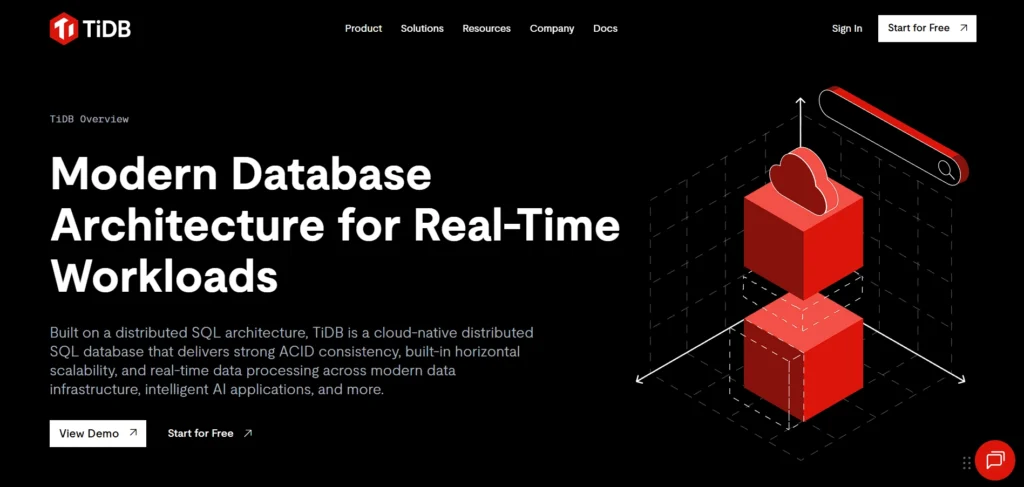
TiDB is a free distributed NewSQL database, which combines scalability and high transactional consistency. Designed to support a large data set it decouples SQL computing and storage thus enabling both to scale independently.
It employs region sharding and two phase commits to ensure integrity of transactions between nodes. TiDB offers the use of TLS to encrypt node communication and generic authentication.
Its distributed architecture makes it fault tolerant, since it copies the data to the servers. TiDB is the best choice in cloud systems where there should be a requirement of scaling, SQL-compatible databases, and consistent transactional guarantees.
Key Features:
- Distributed NewSQL implementation.
- Horizontal scalability
- Transactional consistency
- TLS encryption support
- Automatic sharding
- Cloud-native design
Pros:
- Handles massive workloads
- Open-source foundation
- MySQL compatibility
- High fault tolerance
- Elastic scaling
Cons:
- Needs specialist set up.
- Limited security UI tools
- Less enterprise adoption.
Pricing:
- Request pricing
10. ClickHouse
Website: https://clickhouse.com/
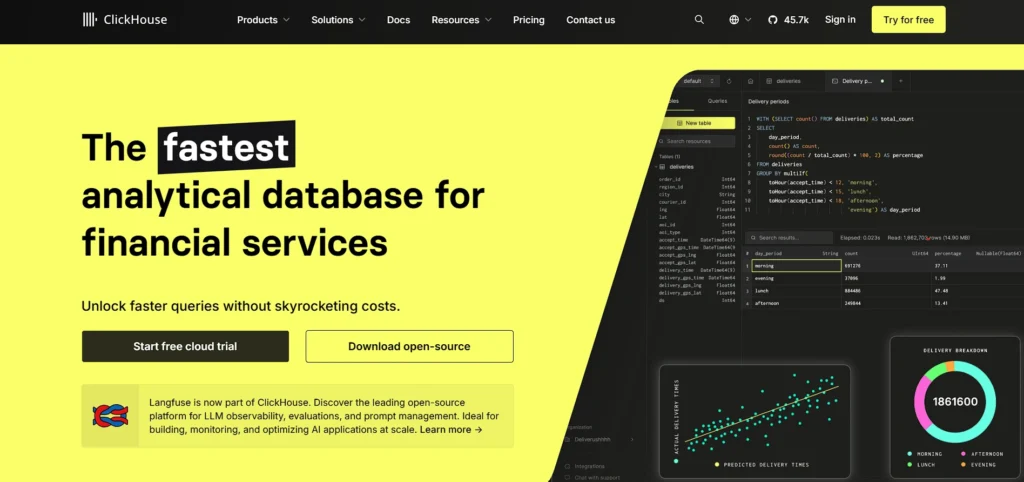
ClickHouse is a high-speed columnar database with an analytical workload. It is extensively deployed in OLAP, real-time reporting, and analytics on logs, and not in heavy transactional processing, making it suitable among secure database management platforms for analytics-focused use cases.
ClickHouse is able to support secure deployment with TLS encryption as well as user-level access control. It is compatible with LDAP and Kerberos to authenticate and authorize to the enterprise and provide database and table permissions on a fine-grained basis.
It has a column-based structure that provides very high query response times on large volumes of data. ClickHouse can be a secure analytics system that serves as a BI and monitoring environment, with the appropriate system configuration.
Key Features:
- Columnar storage engine
- TLS-encrypted connections
- Role-based access control
- LDAP/Kerberos support
- Fast queries of the analytics.
- Distributed processing
Pros:
- Extremely fast analytics
- Efficient storage usage
- Strong OLAP scalability
- Open-source availability
- Excellent performance
Cons:
- Not built for OLTP
- The security configuration required to be done manually.
- Simple transactional characteristics.
Pricing:
- Basic storage: $25.30/ 1TB/ month
- Scale storage: $25.30/ 1TB/ month
11. RavenDB
Website: https://ravendb.net/
RavenDB is a free document database with ACID transactions, clustering and distributed consistency based on the Raft consensus.
It offers powerful authentication and user authorization and user roles. RavenDB is also defaulting TLS encrypted and can be implemented with encrypted data-at-rest storage to ensure the security of data-at-rest.
It has automatic indexing, full-text search, and vector search capability which makes it simple to develop applications without compromising performance. RavenDB is a good match to the current secure document-based applications because of its security measures and flexible deployments.
Key Features:
- ACID document transactions
- UPS TLS encryption is turned on.
- Role-based authorization
- Security policies on a cluster wide basis.
- Inbuilt searching facilities.
- Automatic indexing
Pros:
- Strong security defaults
- Easy replication setup
- Developer-friendly design
- Flexible document model
- High availability support
Cons:
- Smaller ecosystem
- Limited third-party tooling
- Licensing of enterprise needed.
Pricing:
- Custom pricing
12. Amazon DocumentDB
Website: https://aws.amazon.com/documentdb/
Amazon DocumentDB is a managed document database service that is compatible with the MongoDB API, making it one of the secure database management platforms for providing secure and scalable workloads on the cloud.
It isolates compute and storage to provide durability and automatically copies data across three or more Availability Zones. DocumentDB supports AWS KMS and TLS encryption to enable encryption at rest and secure communication, respectively.
Its managed service model handles backups, patching, and monitoring to reduce operational overhead. DocumentDB also integrates with IAM and supports compliance requirements, making it suitable for secure JSON-based applications on AWS.
Key Features:
- REST encryption and transit encryption.
- MongoDB API compatibility
- Automated backups
- Multi-AZ replication
- IAM-based authentication
- Fully managed operations
Pros:
- Minimal maintenance effort
- High availability built-in
- Well-developed AWS security infrastructure.
- Easy scalability
- Compliance-ready service
Cons:
- AWS vendor lock-in
- The parity of MongoDB features is limited.
- Expensive at high usage
Pricing:
- Standard: $0.0822 per DCU hour
- I/O-Optimized: $0.0905 per DCU hour
Future Trends Database Security
- AI-Driven Threat Detection: AI and machine learning will be more frequently applied to databases to recognize abnormal access and stop breaches in real-time.
- Zero Trust Database Access: The security models will be changed to never trust, always verify and implement continuous authentication and strict access controls.
- Confidential Computing: Additional platforms will help secure data in the middle of being processed in memory and lower exposure when running.
- Automated Compliance Control: The built in tools within the databases will be smarter to allow automatic auditing, reporting and compliance monitoring.
- Tighter Encryption Standards: The next generation systems will embrace a high level of encryption algorithm, such as quantum resistance.
- Security Improvements in the Cloud: With the increasing use of cloud, secure databases will provide more integration with cloud IAM, KMS and secure networking.
Conclusion
The security of databases is also developing fast to keep up with the needs of contemporary cyber threats, cloud usage, and tightening compliance requirements. Secure database management platforms are evolving with future developments such as AI-driven monitoring, zero trust access, confidential computing, and enhanced encryption, all of which will contribute to the safety of sensitive data. With these advancements, organizations can create resilient, secure, and future-proof database environments while maintaining trust, continuity, and long-term growth.
FAQs
1. What Lies Ahead Of Database Security?
In the future, there will be threat detection by artificial intelligence, zero trust-based access, and sophisticated encryption techniques.
2. What Is The Significance Of AI In Trends In Database Security?
Artificial intelligence assists in real-time detection of suspicious activities and pre-empt attacks when they are in progress.
3. What Is Zero Trust In Reference To Databases?
Zero trust will make sure that all users and requests are repeatedly authenticated, even on the network.
4. Will There Be An Increase In The Strength Of Encryption?
No, databases will not be using more sophisticated and quantum-resistant encryption standards.
5. What Effect Will Cloud Adoption Have On Database Security?
Cloud-native databases will enhance IAM, integrated compliance, and protection of many clouds.