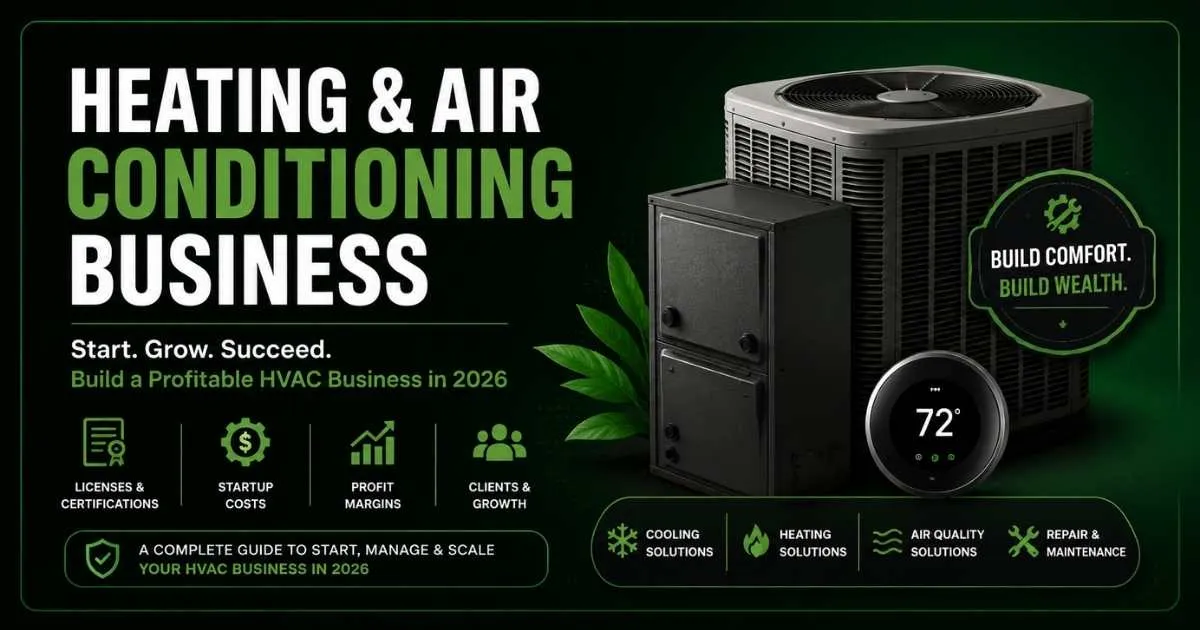
Starting an HVAC business in 2026 is one of the most strategic moves an entrepreneur can make. The U.S. HVAC industry is now projected to reach $165 billion in 2026 — with the global market hitting $302 billion the same year — driven by climate-related demand, aging infrastructure, mandatory refrigerant transitions, and a growing push for energy-efficient systems. If you have ever wondered how to start a heating and air conditioning business, the timing has rarely been better.
This guide combines the latest 2026 market data with a practical, step-by-step roadmap — covering licensing, startup costs, profit margins, equipment brands, client acquisition, and the refrigerant regulatory changes every new HVAC owner must understand.
2026 HVAC Market: Why Now Is the Right Time to Start
The data makes a compelling case for entering the HVAC industry in 2026:
| Metric | 2026 Figure |
| U.S. HVAC Industry (total) | $165 billion (BDR, 2026) |
| Global HVAC Market | $302 billion (OxMaint, 2026); growing at 7.1% YoY |
| U.S. HVAC Systems Market | $33.9 billion; forecast $54B by 2033 at 6.9% CAGR |
| HVAC Services Market (global) | $72.48 billion in 2026; reaching $98.74B by 2031 at 6.38% CAGR |
| Number of U.S. HVAC Businesses | ~120,000 businesses; growing at 2.6% per year |
| HVAC Employment (U.S.) | 1.6 million workers; BLS projects continued growth |
| Fastest-Growing Sub-Segment | Data center cooling (+14.2% CAGR); Heat pump installation (+12.8% CAGR) |
Key demand drivers in 2026 include: climate change increasing extreme weather events; mandatory refrigerant transitions pushing system replacements; Inflation Reduction Act rebates stimulating heat pump adoption; aging commercial building stock (median U.S. commercial building is 44 years old); and 9.9% growth in construction starts through 2026 feeding new installation contracts.
What Is an HVAC Business?
An HVAC business installs, repairs, maintains, and replaces heating, ventilation, and air conditioning systems in residential and commercial properties. A modern HVAC operation in 2026 goes well beyond basic repairs — successful companies also offer:
- New system installation and full replacements
- Preventive maintenance contracts (the highest-margin recurring revenue stream)
- Emergency repair services (24/7 availability commands premium rates)
- Indoor air quality (IAQ) assessments and upgrades
- Energy efficiency audits and smart thermostat installation
- Heat pump installation (the fastest-growing equipment category in 2026)
- A2L refrigerant handling and R-410A system retrofits
The business model blends product sales with high-skill service delivery. Technical expertise in refrigeration, electrical systems, ductwork, and energy management is essential — as is a growing familiarity with IoT-enabled systems and low-GWP refrigerants.
Explore Related Blog: Electronics Companies In India
The 2026 Refrigerant Transition: What Every New HVAC Owner Must Know
This is the most significant regulatory shift in the HVAC industry since the R-22 phase-out — and it directly affects how you will buy equipment, train technicians, and price services in 2026.
What Changed: The AIM Act and R-410A Phase-Out
The American Innovation and Manufacturing (AIM) Act of 2020 authorised the EPA to phase down hydrofluorocarbon (HFC) production by 85% over 15 years. Here is where the timeline stands:
| Date | What Happened |
| Jan 1, 2025 | EPA banned manufacture and import of new residential/light commercial HVAC systems using refrigerants with GWP above 700 — effectively ending new R-410A equipment production. |
| 2025–2026 | Contractors could still install R-410A systems from pre-2025 inventory. A sell-through window extended into early 2026. |
| Jan 1, 2026 | Original installation compliance deadline. EPA signalled low enforcement priority in March 2025 but the transition is effectively underway. All new systems now use A2L refrigerants. |
| 2026 onward | R-410A systems already installed remain legal and serviceable. R-410A prices have risen 40–70% from 2022 levels due to tightening supply. New systems use R-454B or R-32. |
| By 2036 | EPA targets 85% reduction in total HFC production and consumption under the Kigali Amendment. |
The New Refrigerants You Need to Know
- R-454B — GWP ~466; A2L refrigerant; the primary R-410A replacement in new residential systems. Mildly flammable — requires updated tools and A2L safety training.
- R-32 — GWP ~675; A2L refrigerant; widely adopted in ductless and heat pump systems. Meets EPA’s ≤700 GWP threshold.
Why This Matters for Your New Business: All new systems you install from 2026 onward will use A2L refrigerants. You must complete A2L safety training, update your tools and procedures, and factor rising R-410A service costs into your repair pricing. Do not launch without understanding this transition — it affects equipment purchasing, technician training, and liability.
Licenses and Certifications Required to Start an HVAC Business
Operating legally as an HVAC contractor in 2026 requires both federal certifications and state-level licensing. Here is every credential you need:
| Credential | Required? | Details |
| EPA Section 608 Certification | Federal — Mandatory | Required before buying or handling any refrigerant. Four types: Type I (small appliances), Type II (high-pressure), Type III (low-pressure), Universal (all). Exam fee: $20–$50. Obtainable in 1–2 days of study. |
| A2L Refrigerant Safety Training | Effectively mandatory 2026 | Required to work with new R-454B and R-32 refrigerants. Mildly flammable A2L handling is now core to all new residential installs. |
| State Contractor License | Required in most states | Most states require passing trade and business law exams plus documented experience (typically 2–5 years). Contact your state Department of Labor for specifics. |
| Business Registration (LLC) | Strongly recommended | LLC registration protects personal assets. Cost: $100–$500. LLC is the right structure for 95% of HVAC startups. |
| NATE Certification | Optional but valuable | North American Technician Excellence credential. Not legally required but signals quality to customers and enables premium pricing. |
| Local Permits | Varies by municipality | Building and mechanical permits often required before installing systems. Check your local authority having jurisdiction (AHJ). |
HVAC Business Startup Costs in 2026
One of the most common questions from aspiring HVAC owners is: how much does it cost to start? The honest answer is: it depends on your strategy. 2026 startup costs range from $8,500 for a lean solo launch to $150,000+ for a fully-equipped multi-technician operation.
| Cost Category | Lean Launch | Full-Service Launch | Notes |
| Vehicle (van/truck) | $5,000–$15,000 | $40,000–$80,000 | Used cargo van vs. new equipped service vehicle |
| HVAC Tools & Equipment | $2,000–$6,000 | $15,000–$25,000 | Manifold gauges, vacuum pumps, leak detectors, multimeters, A2L-compatible tools |
| EPA 608 + A2L Training | $70–$300 | $300–$1,000 | Certification exam fees plus A2L safety training (now essential) |
| Contractor License & Permits | $200–$800 | $500–$2,500 | Varies significantly by state |
| Business Registration (LLC) | $100–$500 | $100–$500 | One-time filing fee; legal protection for personal assets |
| Insurance | $500–$2,500/yr | $3,000–$8,000/yr | General liability, commercial auto, workers’ compensation |
| Initial Parts & Refrigerant | $1,000–$3,000 | $5,000–$15,000 | Stock of filters, A2L refrigerant, common repair parts |
| Marketing Launch | $500–$2,000 | $2,000–$5,000 | Google Business Profile, local SEO, vehicle wrap, business cards |
| TOTAL RANGE | $8,500–$18,000 | $75,000–$150,000+ | Most solo starters launch lean and reinvest revenue |
Financing Options
If you need capital beyond personal savings, these are the most viable paths in 2026:
- SBA Loans — Government-backed loans with competitive rates and lower down payments. Best for established-credit applicants.
- Equipment Financing — Dedicated loans secured by the vehicle or tools themselves. Lower down payments required.
- Business Line of Credit — Flexible revolving capital for seasonal cash flow gaps or unexpected expenses.
- Vendor Financing — Some HVAC suppliers offer payment terms on initial equipment and parts inventory.
- Personal Investment — Using savings or home equity retains 100% ownership but carries personal risk.
HVAC Franchise vs. Independent Business: Which Is Better in 2026?
| Factor | Franchise Route | Independent Business |
| Upfront Cost | High — franchise fees + mandatory brand investment | Low — LLC registration + licensing + basic tools |
| Brand Recognition | Immediate national/regional brand trust | Built organically over time — slower but 100% yours |
| Operational Control | Fixed playbooks, mandated software, defined territories | Complete freedom — your pricing, schedule, services |
| Ongoing Fees | Weekly/monthly royalty cuts (typically 5–10% of revenue) | Zero royalties — keep every dollar earned |
| Marketing Support | National ad assets and corporate lead pipelines | Your full responsibility — but full ROI stays with you |
| Best For | Investors with capital who want a ready-made system and instant brand | Experienced technicians who want full control, low overhead, and 100% profit retention |
Your HVAC Business Plan: Six Key Sections
A solid business plan is not just a document for lenders — it is your operational blueprint. Here are the six sections every HVAC business plan must include:
1. Executive Summary (Mission, Vision, Differentiators)

Define your mission around delivering reliable, energy-efficient HVAC solutions. Identify what sets you apart: specialisation in A2L refrigerant systems? Commercial clients? Heat pump expertise? Articulate your target market, service area, and long-term growth vision.
2. Services Offered
Map out your full service range from day one:

- Residential and commercial AC installation and replacement
- Furnace and heat pump installation, repair, and replacement
- Duct cleaning, sealing, and sanitisation
- Preventive maintenance contracts (your highest-margin recurring revenue)
- A2L refrigerant system installation and R-410A system servicing
- Indoor air quality (IAQ) assessments and smart thermostat installation
- Emergency repair services (24/7)
3. Local Market Analysis

Research your service area thoroughly: local climate patterns and seasonal demand peaks, housing density and new construction activity, competitor landscape and pricing benchmarks, and any underserved niches (commercial, elderly population, energy retrofits, etc.).
4. Pricing Strategy

Use market-competitive rates as your baseline, then position based on your value proposition:
| Service Type | Typical 2026 Rate | Notes |
| Diagnostic / Service Call | $75–$150 flat fee | Plus hourly labour at $75–$150/hr; or flat-rate pricing per job |
| Preventive Maintenance Visit | $100–$200 per visit | Annual contracts: $150–$500/year; 40–50% profit margin |
| System Installation (residential) | $3,000–$12,000+ | Varies by system type, size, and complexity; 10–20% net margin |
| Emergency Service Call | $200–$500+ | 24/7 availability; premium rates justified by urgency |
| Commercial Contract | Custom project-based | Higher volume, better payment terms, most consistent revenue |
5. Operations Plan
Outline technician hiring and training plans, vehicle fleet size and service territory coverage, scheduling and dispatch processes, quality standards, and customer communication protocols. Build in A2L training programmes from the start — this is now a core operational requirement.
6. Financial Projections
A realistic first-year range for a solo operation is $75,000–$250,000 in gross revenue, with the owner taking home $40,000–$80,000 after expenses. By year three to five, six-figure owner salaries are very achievable with the right systems in place. Target revenue per technician of $250,000–$450,000+ annually once established.
Best HVAC Equipment Brands for New Contractors in 2026
Your equipment brand relationships determine parts availability, warranty quality, and dealer support. These are the top choices for new HVAC businesses:
| Brand | Why It Works for New Contractors | Best For |
| Goodman | Affordable price point with wide parts availability. Excellent for residential budget-conscious clients; easy to stock common parts. | Startups, price-sensitive markets |
| Rheem / Ruud | Strong durability record and mid-range pricing. Popular with independent contractors for reliability and straightforward field servicing. | Balanced residential & light commercial |
| Carrier Global | Known for smart home integration and leading energy efficiency. Innovation in heat pump and A2L technology. Requires dealer agreement. | Premium residential, smart home |
| Trane | Industry-premium product line allowing premium pricing. Strong commercial reputation. Dealer agreement required with territory structure. | Commercial, premium residential |
| Daikin / Mitsubishi | Leading ductless mini-split and VRF technology. Critical brands if you plan to offer ductless system installation, a growing residential segment. | Ductless, heat pumps, additions |
How to Make Money: Revenue Streams and Profit Margins
Understanding where the real money is in HVAC helps you build a service mix that maximises profitability from day one:
| Revenue Stream | How It Works | Profit Margin | Growth Potential |
| Maintenance Contracts | Annual/biannual service plans billed monthly or annually. First-call rights on repairs and replacements. | 40–50% | Very High — recurring |
| Service & Repair | Diagnostic calls, refrigerant recharges, part replacements, emergency callouts. | 20–30% | High — consistent demand |
| System Installation | New HVAC system installs and full replacements. Higher ticket, strong revenue. | 10–20% | High — one-time high value |
| Heat Pump / Energy Retrofits | IRA rebates are driving demand. Position as the expert in high-efficiency heat pump conversion. | 15–25% | Very High — fastest growing |
| Commercial Contracts | Long-term HVAC management for offices, retail, hospitality. Larger systems, stable billing. | 10–18% | Very High — stable and scalable |
| IAQ & Smart Home Add-ons | Air purifiers, smart thermostats, UV systems. Strong upsell opportunity during every service visit. | 25–40% | Medium-High — growing segment |
2026 Profit Benchmarks: According to industry data, a well-run HVAC company in 2026 should generate $250,000–$450,000+ in revenue per technician and achieve 10–20% net profit margin overall (solo operators can hit 15–30%). Median HVAC business owner salary in 2026 is $86,197, with top performers at 15+ technicians earning $300,000–$500,000+.
Seasonal Revenue Patterns and Cash Flow Planning
HVAC businesses experience predictable seasonal peaks. Planning for these cycles is critical in your first two years:
| Season | Revenue Pattern | What to Do |
| Summer (Peak) | Highest demand — AC repairs and replacements | Maximise capacity, prioritise high-margin jobs, pre-order parts to avoid supply delays |
| Winter (Peak) | High demand — furnace and heat pump repairs | Offer emergency service contracts, stock heating parts, prioritise replacements |
| Spring (Shoulder) | Moderate — pre-summer tune-ups | Aggressively market AC maintenance plans; convert service calls to maintenance contracts |
| Autumn (Shoulder) | Moderate — pre-winter tune-ups | Push heating system check-ups; schedule maintenance plan renewals |
Cash flow survival tactics: maintain cash reserves from summer peak revenue to cover winter overhead; promote shoulder-season inspections to keep technicians fully booked; manage inventory by adjusting purchasing behaviour seasonally; offer monthly automatic service plan billing to smooth income year-round.
Read More:
How to Find Your First HVAC Clients
The first 12 months are the hardest for client acquisition. These strategies have the highest ROI for a new HVAC business:
Digital Foundations (Do These First)
- Google Business Profile — Complete and optimise this before anything else. When someone searches ‘AC repair near me’, this is how you show up in the Maps pack.
- Local SEO — Optimise your website for ‘[city] HVAC repair’, ‘[city] air conditioning installation’, and related phrases. This drives the highest-intent traffic.
- Review Generation — Immediately after every completed job, ask satisfied customers for a Google review. Early reviews dramatically accelerate trust-building.
Offline and Relationship Strategies
- Vehicle Wrap — Your service van is a mobile billboard. A professional wrap builds brand recognition across your entire service territory on every trip.
- Property Managers — Building B2B relationships with residential landlords generates consistent recurring service calls without heavy marketing spend.
- Real Estate Agents — Inspections before home sales and system certifications for buyers create a reliable referral pipeline.
- General Contractors and Builders — Becoming a preferred HVAC subcontractor on new construction projects provides steady high-volume installation work.
- Customer Referral Program — Offer incentives (service discounts, gift cards) to existing customers who refer new clients. Word-of-mouth remains the most trusted channel in the trades.
Essential Software for Running an HVAC Business
Operational software is no longer optional — it is the difference between a chaotic solo operator and a scalable, professional company. These are the key platforms:
| Category | Top Platforms | Key Benefit |
| Field Service Management | ServiceTitan, Jobber, FieldEdge, Housecall Pro | Scheduling, dispatch, invoicing, and customer management in one platform |
| CRM | ServiceTitan CRM, Jobber, HubSpot | Track customer history, maintenance schedules, and automate follow-up reminders |
| Accounting / Financial | QuickBooks, FreshBooks, or AI accounting tools | Financial reporting, cost tracking, tax filing, and profitability analysis by job type |
| Scheduling Optimisation | Built into ServiceTitan / Jobber | Route optimisation by technician skill, location, and job complexity — maximise daily output |
| Marketing Automation | Podium, NiceJob, Broadly | Automated review requests, email follow-ups, and social media management |
How to Grow Your HVAC Business
Once your operations are running smoothly, these are the highest-leverage growth strategies:
Build Recurring Revenue First
Maintenance contracts are the foundation of a scalable HVAC business. Every new customer should be offered a service plan at the conclusion of every job. 100 maintenance contracts at $300/year creates $30,000 in guaranteed recurring revenue — plus first-call rights on all repairs and replacements from those accounts.
Expand Service Area Gradually
Grow your territory in phases — ensure staffing and vehicle capacity can maintain quality before extending your radius. Rushing geographic expansion before building operational depth is one of the most common early mistakes.
Specialise in High-Margin Growth Segments
In 2026, the highest-growth HVAC opportunities are heat pump installation (IRA-rebate driven), data centre cooling, commercial maintenance contracts, and IAQ solutions. Becoming the recognised expert in one or two of these areas commands premium pricing and generates referrals.
Build Strategic Partnerships
Develop referral relationships with local contractors, home improvement stores, real estate agents, and property managers. These partnerships produce a consistent flow of pre-qualified leads without heavy advertising spend.
Invest in Technician Development
As you scale, your team quality determines your reputation. Partner with vocational schools for apprentice pipelines, offer competitive wages ($36–$42/hour is now the market rate for experienced technicians in 2026), and invest in A2L and smart HVAC system training to keep technicians current.
Challenges Facing HVAC Businesses in 2026 (and How to Solve Them)
| Challenge | Business Impact | Recommended Solution |
| Skilled Labour Shortage | Delayed projects; capacity constraints | Partner with vocational schools, offer apprenticeships, pay competitive wages ($36–$42/hr for experienced techs) |
| R-410A / A2L Refrigerant Transition | Higher service costs; new tools needed; compliance risk | Complete A2L safety training immediately; update tools; stock A2L-compatible parts; price R-410A service work to reflect rising refrigerant costs (up 40–70%) |
| Seasonal Revenue Fluctuation | Inconsistent cash flow | Build maintenance contract revenue for year-round baseline income; diversify into commercial and IAQ services |
| Rising Equipment & Part Costs | Lower margins if pricing is not adjusted | Build strategic supplier relationships; review pricing quarterly; be transparent with customers about cost drivers |
| Regulatory Compliance Complexity | Risk of fines or licence issues | Subscribe to ACCA, ASHRAE newsletters; join state contractor association; designate one team member as compliance lead |
| Customer Price Sensitivity | Difficulty maintaining premium pricing | Quantify long-term savings (energy bills, repair avoidance) for customers; bundle financing options; compete on reliability not just price |
| Marketing & Online Visibility | Difficulty standing out locally | Invest in Google Business Profile, local SEO, and review generation. These three alone drive 70%+ of local HVAC leads. |
Conclusion
Learning how to start a heating and air conditioning business in 2026 means entering a market with exceptional structural tailwinds. The U.S. HVAC industry is worth $165 billion. The global market has crossed $302 billion. Refrigerant regulations are forcing millions of system replacements. IRA rebates are accelerating heat pump adoption. And an aging HVAC workforce means the technician shortage will only deepen — creating pricing power for well-run, customer-focused operations.
The path to a successful HVAC business is clear: get licensed correctly (including A2L training), start lean or structured depending on your capital, build a foundation of maintenance contract revenue, and invest in the technology and team quality that support growth. First-year income of $50,000–$100,000 as a solo operator can grow to $100,000–$300,000+ by year five with the right systems in place.
The HVAC industry rewards preparation, technical excellence, and reliable customer service. Entrepreneurs who bring all three to this market in 2026 will find a profitable, durable, and genuinely vital business to build.
Also Read:
- Small Business Ideas in Kolkata
- Highest Paying Trade Jobs
- Starbucks Franchise Cost
- 7 Days Loan App List
FAQs
How much does it cost to start an HVAC business in 2026?
Startup costs range from $8,500–$18,000 for a lean solo launch to $75,000–$150,000+ for a full-service multi-technician operation. The main expenses are a service vehicle, EPA and A2L certification, state contractor licensing, tools, insurance, and initial parts inventory.
What certifications are required to start an HVAC business?
The minimum federal requirement is EPA Section 608 Certification, which authorises you to purchase and handle refrigerants. As of 2026, A2L refrigerant safety training is also effectively required for working with new R-454B and R-32 refrigerants. Most states additionally require a state-level HVAC or mechanical contractor licence, typically requiring 2–5 years of documented experience.
Is the R-410A phase-out a problem for new HVAC businesses starting in 2026?
It is a key consideration, not a dealbreaker. All new systems installed in 2026 use A2L refrigerants (R-454B or R-32). New HVAC owners should complete A2L safety training and acquire compatible tools before launching. R-410A systems already installed remain legal and serviceable, but refrigerant costs have risen 40–70%, so factor this into repair pricing.
What are typical HVAC profit margins in 2026?
Maintenance contracts: 40–50% gross margin. Service and repair work: 20–30%. System installations: 10–20%. Overall company net margins: 10–20% for well-run businesses, with solo operators reaching 15–30%. Revenue per technician benchmark: $250,000–$450,000+ annually.
How long does it take to start an HVAC business?
If you already have HVAC experience and certifications, you can launch in 1–3 months (licence processing, insurance, vehicle and tools acquisition). Starting from scratch without certifications or experience typically takes 6 months to 5 years, depending on your training path.
Is an HVAC franchise or independent business better in 2026?
Choose a franchise if you have significant launch capital and want instant brand recognition with a proven operational playbook. Build independently if you want full operational control, lower overhead, no royalty payments, and 100% profit retention. Most experienced technicians start independently.
How do I find my first HVAC clients?
Prioritise: (1) Google Business Profile optimisation for local search visibility, (2) a professional vehicle wrap for brand recognition, (3) property manager relationships for consistent residential service calls, (4) review generation after every completed job, and (5) a customer referral incentive programme.
What is the best HVAC equipment brand for a startup?
Goodman is the most popular startup choice due to affordability and wide parts availability. Rheem and Ruud offer better durability at mid-range prices. Carrier and Trane command premium pricing but require dealer agreements. For ductless mini-split work, Daikin and Mitsubishi are the market leaders.