
If you have ever thought about starting your own business in India, the Amul franchise is probably one of the first names that came to your mind. And honestly? There is a solid reason for that.
Amul is not just a dairy brand. It is a habit for most Indian households. Butter in the morning, milk at night, ice cream in summer — Amul is everywhere. That is exactly why owning an Amul outlet is one of the safest and most profitable small business ideas in India right now, especially in 2026.
For aspiring entrepreneurs looking to join this legacy, understanding the Amul Franchise Cost in India is essential. This investment opens doors to becoming part of a trusted brand with a proven business model and national presence.
In this guide, we are going to break down everything you need to know — from the types of Amul franchises available, the actual cost to start, how much profit you can make every month, and the exact steps to apply online. No fluff. Just what you need to know.
Quick fact: Amul (GCMMF) crossed ₹61,000 crore in revenue and is India’s No. 1 dairy brand with over 10,000+ franchise partners across the country.
What is Amul Franchise? A Quick Background
Before we get into the numbers, let’s understand what you are actually signing up for.
Amul — short for Anand Milk Union Limited — was started in 1946 by dairy farmers in Anand, Gujarat who were tired of being exploited by middlemen. It was built as a cooperative, meaning the farmers own it, run it, and benefit from it directly. That cooperative spirit is what makes Amul different from any other brand.
Today, Amul is managed by GCMMF (Gujarat Co-operative Milk Marketing Federation) and has:
- Over 36 lakh (3.6 million) milk producer members
- 18,600+ village dairy cooperative societies
- 87 sales offices and 15,000+ dealers across India
- 8,300+ Amul Preferred Outlets (franchise stores)
- A product portfolio of 1,500+ SKUs including milk, butter, cheese, paneer, ice cream, chocolates, and more
Now here is the most important part for anyone considering a franchise — when you open an Amul outlet, you are not starting from zero. You are plugging into a brand that every Indian already trusts. Starting an Amul franchise represents an intelligent business move that ensures both security and simple management, together with strong investment potential—making it a prime example of a successful franchise business in India.
Types of Amul Franchise in India (2026)
Amul does not offer a one-size-fits-all franchise model. Depending on your budget, available space, and location, you can choose from multiple types of outlets. Let’s look at each one:
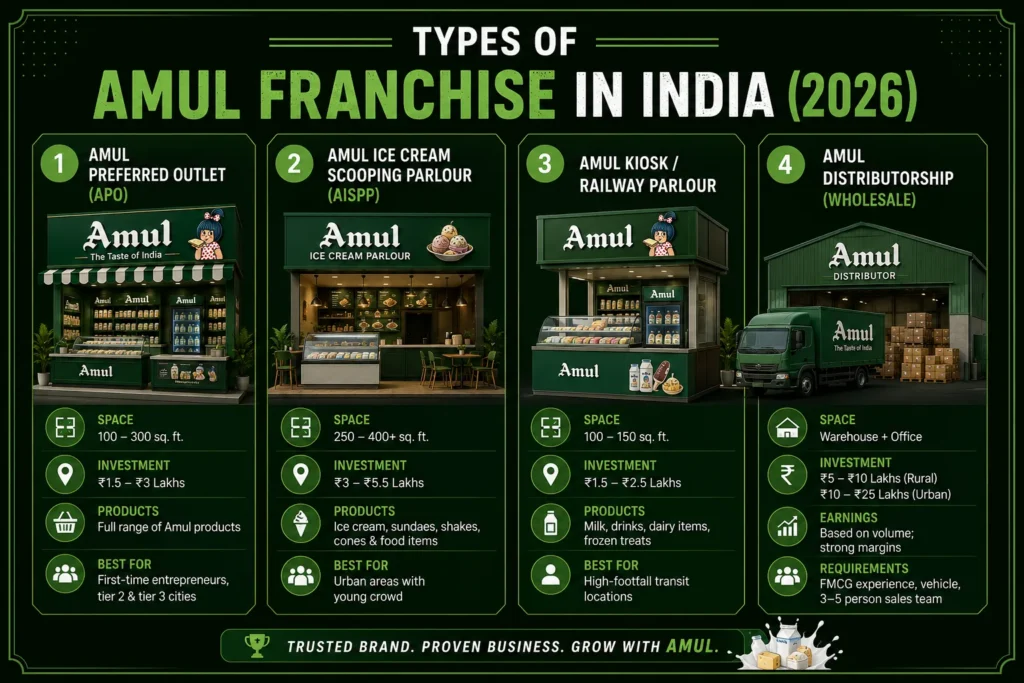
1. Amul Preferred Outlet (APO)
This is the most common and popular Amul franchise model. Think of it like a full dairy store where you sell everything — milk, butter, curd, paneer, cheese, beverages, chocolates, and even naturals Ice Cream.
- Space needed: 100 to 300 sq. ft.
- Ideal location: Residential areas, local markets, malls, commercial complexes
- Investment range: ₹1.5 lakh to ₹3 lakhs
- Products: Full range of Amul products
Best for: First-time entrepreneurs, people in tier 2 and tier 3 cities, those looking for a steady daily-income business.
2. Amul Ice Cream Scooping Parlour (AISPP)
This one is all about ice cream. It works like a small dessert café where you serve Amul ice cream scoops, sundaes, milkshakes, and more — and sometimes hot snacks too like pizza and sandwiches made with Amul products.
- Space needed: 250 to 400+ sq. ft.
- Ideal location: Near schools, colleges, malls, entertainment zones, high-footfall streets
- Investment range: ₹3 lakh to ₹5.5 lakhs
- Products: Ice cream scoops, sundaes, shakes, cones, possibly food items using Amul cheese/butter
Best for: Entrepreneurs in urban areas or places with a young crowd. Summer months drive extremely high sales.
3. Amul Kiosk / Railway Parlour
This is a compact, modular stall format. It can be set up in smaller spaces and works perfectly in transit zones like railway stations, bus terminals, metro stations, office complexes, or school campuses.
- Space needed: 100 to 150 sq. ft.
- Ideal location: Railway stations, bus stops, metro stations, office parks
- Investment range: ₹1.5 lakh to ₹2.5 lakhs
- Products: Milk pouches, flavoured drinks, packaged dairy items, some frozen treats
Best for: Investors with limited budget and high-footfall transit locations. Lower setup cost, faster break-even.
4. Amul Distributorship (Wholesale)
This is not a retail franchise — it is a distribution business. As an Amul distributor, you supply Amul products in bulk to retailers, parlours, supermarkets, and other stores in your assigned area.
- Space needed: Warehouse + small office
- Investment range: ₹5 lakh to ₹10 lakhs (rural) and ₹10 lakh to ₹25 lakhs (urban)
- Earnings: Based on volume; strong margins on bulk supply
- Requirements: FMCG experience preferred, vehicle for delivery, 3-5 person sales team
Best for: Entrepreneurs with business experience, logistics access, and capital to invest in supply chain operations.
Amul Franchise Cost in India 2026 — Complete Breakdown
Let’s get into the actual numbers. Here is the full cost breakdown for each franchise type:
| Franchise Type | Space Required | Security Deposit | Renovation / Interiors | Equipment | Initial Stock | Total Investment |
| Amul Preferred Outlet (APO) | 100–300 sq. ft. | ₹25,000 (refundable) | ₹80,000–₹1,00,000 | ₹70,000–₹80,000 | ₹50,000–₹1 lakh | ₹1.5 lakh – ₹3 lakhs |
| Amul Ice Cream Scooping Parlour | 250–400 sq. ft. | ₹50,000 | ₹1,50,000–₹2,00,000 | ₹1,00,000–₹1,50,000 | ₹50,000–₹1 lakh | ₹3 lakhs – ₹5.5 lakhs |
| Amul Kiosk / Railway Parlour | 100–150 sq. ft. | ₹25,000 | ₹50,000–₹70,000 | ₹50,000–₹70,000 | ₹30,000–₹50,000 | ₹1.5 lakh – ₹2.5 lakhs |
| Amul Distributorship (Urban) | Warehouse + Office | ₹50,000+ | Variable | Vehicle required | Bulk stock | ₹10 lakhs – ₹25 lakhs |
A few important things to note here:
- The security deposit for APO and Kiosks is refundable when you exit the franchise
- Shop rent or commercial space lease is not included — that is separate based on your city and area
- Amul charges NO royalty and NO profit-sharing fee — every rupee you earn after expenses is yours
- Cost of renovation can vary — Amul provides design specs, but execution is on you
Amul Franchise Profit Margin — How Much Can You Actually Earn?
This is the part everyone is really curious about. Let’s be honest about both the upside and the reality.
Amul has fixed retail margins on its MRP, and they do not change based on negotiation. Here is what you earn per product category:
| Product Category | Profit Margin on MRP | Notes |
| Pouch Milk | ~2.5% | Low margin but high daily volume |
| Milk Products (Butter, Curd, Paneer, Ghee) | ~9% to 10% | Steady sellers year-round |
| Ice Cream & Frozen Products | ~20% | Highest margin — key revenue driver |
| Chocolates & Beverages | ~15% to 20% | Good margins, growing demand |
| Cheese & Value-Added Products | ~10% to 15% | Premium range, urban buyers |
Monthly Earnings — What’s Realistic?
Amul itself projects a monthly sales turnover of ₹5 lakh to ₹10 lakh for a well-located outlet. The actual profit after cost of goods (buying products from Amul at wholesale) depends on your product mix and location.
Here is a realistic picture for different outlet types:
| Outlet Type | Monthly Revenue (Approx.) | Monthly Profit (Approx.) | Break-Even Period |
| Amul Preferred Outlet (APO) | ₹3 lakh – ₹8 lakh | ₹30,000 – ₹80,000 | 12 to 18 months |
| Amul Ice Cream Parlour | ₹4 lakh – ₹10 lakh | ₹60,000 – ₹2 lakh | 12 to 24 months |
| Amul Kiosk | ₹2 lakh – ₹5 lakh | ₹20,000 – ₹50,000 | 10 to 15 months |
| Amul Distributorship | High volume-based | ₹1 lakh – ₹3 lakh+ | 18 to 36 months |
Real-world tip: Your location is everything. An outlet near a school, hospital, or residential colony with 500+ families will always outperform an outlet on a quiet street. Do not compromise on footfall when selecting your space.
Also worth knowing — ice cream season (March to July) can literally double your monthly revenue. Smart franchisees plan their inventory and staffing accordingly.
Who Can Apply for an Amul Franchise? Eligibility Criteria
The good news is that Amul’s eligibility requirements are very flexible. You do not need to be a big investor or have prior business experience.
Here is what Amul generally looks for:
| Criteria | APO / Kiosk | Distributorship |
| Minimum Age | 18 years | 21 years |
| Education | 10th pass (rural) / 12th pass (urban) | 12th pass minimum |
| Space Available | 100–300 sq. ft. (retail) | Warehouse + office space |
| Investment Capacity | ₹1.5 lakh – ₹5.5 lakhs | ₹5 lakh – ₹25 lakhs |
| FMCG Experience | Not required | Preferred |
| Business Track Record | Clean reputation in community | Clean track record required |
There is no formal test or interview process for small retail outlets (APO/Kiosk). Amul’s team mostly evaluates your location and investment readiness.
Documents Required for Amul Franchise
Make sure you have these ready before you apply. Missing documents can delay your approval.
Personal Documents
- Aadhaar Card (Identity + Address Proof)
- PAN Card
- Passport-size photographs
- Email ID and active mobile number
- Education/qualification certificate
Property / Space Documents
- Shop agreement / sale deed
- Rent agreement (if rented space)
- NOC from property owner (if applicable)
Business / Legal Documents
- GST Registration Number
- Food License (FSSAI)
- Trade License for the outlet
- Current account details + cancelled cheque (for distributorship)
Pro tip: Start your FSSAI food license application early. It can take 7–15 working days and is mandatory before you start operating.
How to Apply for Amul Franchise Online — Step-by-Step Process
Applying for an Amul franchise is actually straightforward. You can do it online in less than 30 minutes. Here is the exact process:
- Go to the official Amul website: www.amul.com
- Scroll to the bottom of the homepage and click on ‘Amul Parlours’
- On the Amul Parlours page, click on ‘Online Form for Amul Parlour’
- Fill in your personal details — name, contact number, email, city, preferred location, and available space
- Submit the form. You will receive a confirmation on your registered email/number
- Amul’s regional team will contact you within 1–2 weeks for verification and next steps
- Once your location is approved, sign the franchise agreement and pay the security deposit
- Amul provides branding materials, store design guidelines, and connects you with the nearest wholesale dealer
- Set up your store as per Amul’s specifications and stock up with initial inventory
- You are ready to open!
You can also email Amul directly at retail@amul.coop for queries or to check the status of your application.
Approval timeline: If your location checks out and documents are in order, approval typically happens within 1 to 2 weeks.
Amul Franchise Cost by City (2026 Estimates)
The base investment is similar across India, but the actual cost can vary slightly by city depending on commercial real estate and renovation costs. Here is a quick reference:
| City | Estimated APO Investment | Estimated Ice Cream Parlour Investment | Notes |
| Mumbai | ₹2 lakh – ₹4 lakhs | ₹4 lakh – ₹6 lakhs | High rent areas; plan for extra real estate cost |
| Delhi / NCR | ₹2 lakh – ₹4 lakhs | ₹4 lakh – ₹6 lakhs | Strong demand in residential colonies |
| Bengaluru | ₹1.5 lakh – ₹3.5 lakhs | ₹3.5 lakh – ₹5.5 lakhs | IT corridors = high footfall |
| Ahmedabad | ₹1.5 lakh – ₹3 lakhs | ₹3 lakh – ₹5 lakhs | Amul’s home state; strong brand pull |
| Vadodara | ₹1.5 lakh – ₹3 lakhs | ₹3 lakh – ₹5 lakhs | Steady demand; competitive market |
| Chandigarh | ₹1.5 lakh – ₹3 lakhs | ₹3 lakh – ₹5 lakhs | Good for residential zone outlets |
| Chennai | ₹1.5 lakh – ₹3.5 lakhs | ₹3 lakh – ₹5.5 lakhs | Ice cream is a year-round product here |
| Tier 2 & 3 Cities | ₹1.5 lakh – ₹2.5 lakhs | ₹2.5 lakh – ₹4 lakhs | Lower setup cost; rising demand |
Tier 2 and Tier 3 cities are actually becoming a sweet spot for Amul franchises right now. Less competition, lower real estate costs, but rapidly growing demand — especially as Amul keeps expanding its product range into health drinks, probiotic curd, and premium cheese.
Honest Pros and Cons of Taking an Amul Franchise
We want to give you a real picture — not just a sales pitch. Here is what is great and what you should be aware of:
Why Amul Franchise is a Good Idea
- No royalty fees — zero profit sharing with the company
- Zero franchise fee — you only pay a refundable security deposit
- Strong brand trust — customers come to you; you do not have to chase them
- Daily demand — dairy is an everyday essential, not a seasonal luxury
- Amul provides branding support, store design guidelines, and promotional materials
- Wide product range — multiple revenue streams from one outlet
- Steady supply through authorized wholesale dealers — no sourcing hassle
- Year-round business with seasonal peaks (ice cream in summer, ghee/butter in winter)
Things to Keep in Mind
- Milk margins are thin (only ~2.5%) — you need high volume to make pouch milk profitable
- Location is critical — a bad location can kill even the best outlet
- You cannot sell competitor dairy brands in your Amul outlet
- Cold chain infrastructure (freezers, refrigerators) requires upkeep and power backup
- Distributorship requires significant working capital and logistics management
- Success depends heavily on your own hustle, customer service, and daily management
Honest verdict: The Amul franchise is not a passive income business. It rewards hard work and smart location selection. If you pick the right spot and manage it well, it is genuinely one of the best low-risk business opportunities in India.
Amul Franchise vs Other Dairy Franchise Options in India
Before you decide, it helps to see how Amul stacks up against other popular franchise options in the dairy and food space:
| Parameter | Amul Franchise | Mother Dairy | Kwality Wall’s | Baskin Robbins |
| Investment | ₹1.5L – ₹5.5L | ₹5L – ₹10L | ₹3L – ₹8L | ₹10L – ₹20L |
| Franchise Fee | None | Moderate | Moderate | High |
| Royalty | Zero | Low % | ~5% | ~8–10% |
| Brand Recognition | Highest in India | Strong (North India) | Moderate | Moderate |
| Product Range | 1,500+ SKUs | Limited | Ice cream only | Ice cream only |
| Best For | All-round daily business | North Indian markets | Ice cream focus | Premium urban areas |
| Break-Even | 12–18 months | 18–24 months | 18–24 months | 24–36 months |
The conclusion is pretty clear. For most Indian entrepreneurs — especially those starting out — Amul wins on almost every parameter.
Tips to Make Your Amul Franchise More Profitable
Opening the outlet is step one. Making it profitable is step two. Here are things that successful Amul franchisees actually do:
Choose Your Location Wisely
A spot near a residential society, school, hospital, or daily market will always outperform a quiet commercial street. Aim for minimum 400–500 people walking past your shop daily.
Push Ice Cream Aggressively in Summer
Ice cream margins (up to 20%) are your best friend. Stock well before summer and promote actively. A good ice cream season from March to July can fund the rest of your year.
Stock the Right Product Mix
Do not just keep milk pouches. The real money is in milk products — butter, paneer, cheese, curd, ghee. Stock these well and do not let them run out.
Maintain Hygiene and Display Standards
Amul has strict branding and display guidelines. A clean, well-stocked, well-lit outlet naturally attracts more customers and builds loyalty.
Get on Google Maps
List your outlet on Google Maps as ‘Amul Parlour [Your Area]’. Many people search ‘Amul franchise near me’ and this alone can bring you walk-in customers every day — for free.
Consider Home Delivery
Even a simple WhatsApp-based delivery system for nearby housing societies can significantly boost your monthly volume without major extra investment.
Leverage Festive Seasons
Amul rolls out special products and promotions around Diwali, Holi, and Eid. Stock festive gift packs, sweets, and special editions early. These sell fast and at good margins.
What’s New for Amul Franchise in 2026?
The dairy market in India is evolving fast, and Amul is keeping pace. Here are the key developments you should know about as a prospective franchisee in 2026:
- Amul has been expanding aggressively into probiotic curd, plant-based beverages, and high-protein dairy — these products are growing fast and carry better margins
- Digital payment infrastructure is now standard at most Amul outlets — UPI, credit/debit cards, and even QR-code billing are expected by customers
- Tier 2 and Tier 3 city expansion is Amul’s biggest 2026 priority — franchisees in smaller cities are getting faster approvals and more active dealer support
- Amul Delivery App integration is being tested in select cities — allowing customers to order from their nearest Amul outlet directly
- ONDC (Open Network for Digital Commerce) presence is growing — franchisees listed on ONDC platforms are seeing an uptick in home delivery orders
- India’s dairy market is projected to reach $377 billion by 2030 — Amul franchisees are well-positioned to ride this growth
2026 opportunity alert: If you are in a tier 2 or tier 3 city where an Amul outlet does not exist yet, you are sitting on untapped gold. Get in early.
Final Thoughts
Starting an Amul franchise is a smart business idea for anyone interested in the food and dairy sector. The risk, the investment, the uncertainty — it is all real. But here is the thing about an Amul franchise: the fundamentals are genuinely solid.
You are not betting on an unknown brand. You are not building something from scratch. You are partnering with a 78-year-old cooperative that has survived every economic cycle India has thrown at it. People bought Amul butter during COVID. They bought Amul milk during floods. They will buy Amul ice cream this summer, and the summer after that.
The opportunity is real. The investment is manageable. And for the right person, in the right location — it works.
If you are serious about starting, take these three steps today:
- Visit www.amul.com and check the Amul Parlours section
- Scout 2 or 3 possible locations in your area and check the daily footfall
- Fill out the application form and start the conversation with Amul’s team
That’s it. The rest follows from there.
Also Read:
Frequently Asked Questions (FAQs)
Q1. Is Amul franchise profitable in 2026?
Yes, absolutely. An Amul franchise remains one of the most reliable small business investments in India. With zero royalty, no franchise fee, a trusted brand, and daily demand for dairy products, profitability is achievable within 12 to 18 months for most well-located outlets.
Q2. What is the minimum investment to start an Amul franchise?
You can start with as low as ₹1.5 lakhs for an Amul Kiosk. An Amul Preferred Outlet (APO) starts around ₹1.5 lakh to ₹3 lakhs, while an Ice Cream Scooping Parlour requires ₹3 lakhs to ₹5.5 lakhs.
Q3. Does Amul charge a royalty fee?
No. This is one of the biggest advantages of the Amul franchise. Amul does not charge any franchise fee, royalty fee, or profit-sharing. Your profits are 100% yours after operating expenses.
Q4. How much space do I need to open an Amul outlet?
A minimum of 100 sq. ft. is sufficient for an Amul Kiosk or APO. An Ice Cream Scooping Parlour ideally needs 250 to 400 sq. ft. for a comfortable in-store experience.
Q5. How do I apply for Amul franchise online?
Visit www.amul.com, go to the ‘Amul Parlours’ section, and fill out the online application form. You can also write to retail@amul.coop. The approval process typically takes 1 to 2 weeks once your documents and location are verified.
Q6. Can I run an Amul franchise without prior business experience?
Yes. Amul does not require prior business experience for APOs and Kiosks. The operation is simple — you receive stock from the wholesale dealer, stock your shelves, and sell at MRP. Amul provides guidance on store setup and display.
Q7. What is the profit margin on Amul ice cream?
Amul ice cream offers the highest margin in the product portfolio — up to 20% on MRP. This makes the Ice Cream Scooping Parlour model particularly attractive for high-footfall urban locations.
Q8. What documents do I need for an Amul franchise?
You will need your Aadhaar card, PAN card, photographs, FSSAI food license, GST registration, property documents (shop agreement or rent agreement), and trade license for your city.
Q9. Is Amul franchise better than other dairy franchises?
For most Indian markets, yes. Amul’s zero-royalty model, widest product range, highest brand recognition, and lowest investment make it the top choice compared to alternatives like Mother Dairy, Kwality Wall’s, or Baskin Robbins.
Q10. Can I open multiple Amul outlets?
Yes. If you meet the financial and operational requirements for each outlet, Amul allows you to operate multiple franchise locations. Many successful franchisees start with one APO and expand to additional outlets over time.