The U.S. juice and smoothie market is on track to surpass $3.5 billion in 2026, and Smoothie King — the original smoothie franchise since 1973 — sits right at the center of this boom. With over 1,200 active locations and a menu built around clean ingredients, functional nutrition, and purpose-driven wellness, Smoothie King is one of the most recognizable health franchise brands in America.
This guide is written for first-time franchise buyers. Whether you have never invested in a franchise before or are comparing multiple options, we will walk you through every number you need — from the real upfront cost to what your earnings could look like — based on the most current 2026 Franchise Disclosure Document (FDD) data available in 2026.
What Is Smoothie King? (2026 Brand Overview)
Smoothie King was founded in 1973 in New Orleans, Louisiana by Steve Kuhnau — a man who was allergic to many foods and began blending custom nutritional drinks for his own health. That personal origin story became a business model built on real results.
In 2012, Korean entrepreneur Wan Kim purchased the company and relocated HQ to Dallas, Texas. Since then, Smoothie King has expanded aggressively, now counting 1,201 total units globally as of 2026, of which 1,149 are franchise-owned.
What separates Smoothie King from generic smoothie bars is its Clean Blends philosophy — no artificial colors, no artificial flavors, and a commitment to whole food ingredients. The menu targets fitness goals, meal replacement, and dietary preferences including keto, vegan, high-protein, and low-sugar lifestyles.
In 2026, Smoothie King launched its Power Eats menu — the brand’s first nationwide food lineup including toast items — expanding its revenue opportunity per visit and entering the breakfast daypart for the first time. Same-store sales grew 11.5% in 2023, reflecting strong organic momentum going into 2026.
Smoothie King Franchise Cost 2026 — Full Investment Breakdown
The total cost of opening a Smoothie King franchise in 2026 ranges from $312,000 to $1,379,000 depending on location type, store format, real estate market, and build-out costs. The wide range reflects the difference between a small in-line strip mall location and a freestanding drive-thru unit in a high-traffic urban market.
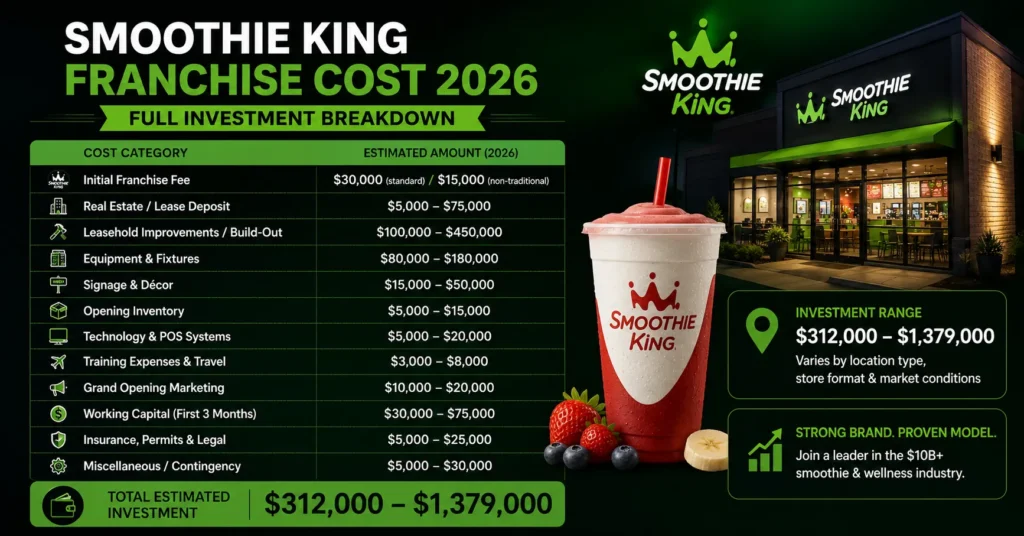
Here is the full breakdown based on 2026 FDD data:
| Cost Category | Estimated Amount (2026) |
|---|---|
| Initial Franchise Fee | $30,000 (standard) / $15,000 (non-traditional) |
| Real Estate / Lease Deposit | $5,000 – $75,000 |
| Leasehold Improvements / Build-Out | $100,000 – $450,000 |
| Equipment & Fixtures | $80,000 – $180,000 |
| Signage & Décor | $15,000 – $50,000 |
| Opening Inventory | $5,000 – $15,000 |
| Technology & POS Systems | $5,000 – $20,000 |
| Training Expenses & Travel | $3,000 – $8,000 |
| Grand Opening Marketing | $10,000 – $20,000 |
| Working Capital (First 3 Months) | $30,000 – $75,000 |
| Insurance, Permits & Legal | $5,000 – $25,000 |
| Miscellaneous / Contingency | $5,000 – $30,000 |
| TOTAL ESTIMATED INVESTMENT | $312,000 – $1,379,000 |
Beginner Tip: Which Format Costs Less?
An in-line or end-cap location (inside a strip mall) sits at the lower end — roughly $312K to $550K. A freestanding drive-thru unit, while more expensive upfront ($600K–$1.37M), typically generates 20% more annual revenue, according to Smoothie King’s own data. Drive-thrus have become the growth standard post-2020.
Franchise Fee Details
The $30,000 franchise fee is paid once upfront and is non-refundable. For non-traditional locations (airports, college campuses, hospitals, fitness clubs), the fee drops to $15,000. Smoothie King also offers a 20% discount on the franchise fee for U.S. military veterans — bringing the cost down to $24,000 for standard locations.
Multi-unit developers receive reduced fees for second and subsequent locations, making Smoothie King a compelling option for entrepreneurs planning to open 3–10 units over time.
Ongoing Fees: Royalties, Marketing & Local Spend
| Fee Type | Amount |
|---|---|
| Royalty Fee | 6% of gross sales (min. $500/month) |
| National Marketing Fund | 3% of gross sales |
| Local Store Marketing | 2% of gross sales (required) |
| Technology / System Fee | Included in royalty structure |
| Total Ongoing % of Sales | ~11% of gross sales |
The 6% royalty fee is standard within the QSR and smoothie franchise space. In exchange, franchisees receive national brand advertising, proprietary software access, supply chain pricing, and ongoing field support. The 3% national marketing fund fuels TV, digital, and social campaigns. Local marketing spend of 2% is required to be documented and reported to Smoothie King.
Important nuance: If no Regional Marketing Fund exists in your area AND you fail to spend the required 2% locally, your national marketing fee increases to 5% — effectively penalizing under-investment in local promotion. Stay compliant.
Revenue & Profit Potential: What the Numbers Say
Let’s talk money — the question every aspiring franchisee asks first.
| Performance Tier | Average Annual Revenue (AUV) |
|---|---|
| System-Wide Average (All Locations) | $627,000 |
| Top 50% of Locations | $731,000+ |
| Top 25% of Locations | $830,000 – $934,000 |
| Top Performing Stores (Drive-Thru) | $1,000,000+ |
What Do These Numbers Mean for Profit?
Revenue is not profit. After accounting for royalties (~11% of sales), food cost (~30–35%), labor (~25–30%), and occupancy/utilities (~10–15%), a typical Smoothie King franchisee may see store-level EBITDA (operating profit before taxes, depreciation, and debt service) of approximately 15–22% of revenue.
On a $627,000 AUV store at 18% EBITDA margin, that equals approximately $112,860 in annual store-level operating profit before loan repayments, personal salary, and taxes.
Top-tier stores doing $900K+ at the same margin can generate $162,000+ annually. Stores in premium, high-traffic locations with drive-thru access consistently outperform the system average.
2026 Growth Signal
Smoothie King recorded 15 consecutive quarters of 20+ new store commitments through 2026, and is actively incentivizing development in 13 underrepresented markets in 2026 including Illinois, Michigan, Virginia, Pennsylvania, and Colorado — offering financial incentives for early movers in those territories.
Who Qualifies? Franchisee Requirements for 2026
Smoothie King is selective — not because they want to limit growth, but because franchisee quality directly impacts brand reputation. Here are the minimum requirements:
| Requirement | Details |
|---|---|
| Net Worth | $300,000 minimum |
| Liquid Capital | $100,000 minimum |
| Credit Score | 680+ preferred |
| Industry Experience | Not required |
| Business/Management Experience | Strongly preferred |
| Owner Involvement | Full-time or dedicated manager required |
| Multi-Unit Opportunity | Yes — reduced fees for additional locations |
| Financing Availability | Third-party lenders; SBA-loan eligible |
The ideal Smoothie King franchisee does not need to have worked in food service before. What they do need: a willingness to follow systems, leadership skills to manage a team, and genuine alignment with health and wellness as a lifestyle — not just a business category. Smoothie King’s best franchisees are community connectors who actively market locally and build loyal customer bases.
Training & Support System
One major advantage for first-time franchise owners: Smoothie King provides a comprehensive onboarding and training program that covers everything before you open your doors.
Initial Training
- Classroom Training: Approximately 11 days at Smoothie King HQ (Dallas, Texas) or virtually for qualifying candidates
- In-Store Training: Hands-on instruction at an operating unit prior to opening
- Grand Opening Support: A Smoothie King field representative stationed at your location for up to 5 days during opening week
- Proprietary Operations Software: POS training, inventory management system, and loyalty program setup
Ongoing Support
- Regular field visits from franchise business consultants
- Annual franchise convention and regional training events
- Marketing toolkit updates with seasonal campaigns and social media content
- New product launch training and menu rollout support
- Real estate and site selection guidance with data-driven territory analysis
- Access to Smoothie King’s vetted supplier network for cost-effective ingredient sourcing
Store Formats & Location Strategy
Smoothie King operates in multiple store formats, giving franchisees flexibility based on available real estate and budget:
| Store Format | Description & Notes |
|---|---|
| Freestanding Drive-Thru | Highest revenue format. Standalone building with drive-thru lane. Avg 20% more revenue vs. walk-in only. |
| End-Cap with Drive-Thru | Corner unit in strip mall with drive-thru. Cost-effective with strong visibility. |
| In-Line / End-Cap (No Drive-Thru) | Interior strip mall unit. Lower cost. Best for walkable areas. |
| Non-Traditional | Airports, college campuses, hospitals, gyms. $15K franchise fee. Lower build-out. |
| Mixed-Use / Urban Kiosk | High foot-traffic areas. Compact format. Lower investment threshold. |
Site selection is data-driven. Smoothie King evaluates candidate territories using population density, household income, proximity to fitness centers and gyms, daytime traffic counts, and co-tenancy (being near complementary health and fitness brands). Locations near Planet Fitness, Anytime Fitness, CrossFit gyms, and university campuses consistently outperform the system average.
How to Apply: Step-by-Step Process
The typical timeline from initial inquiry to grand opening is 6–12 months. Here is exactly how it works:
- Submit Inquiry Form at smoothiekingfranchise.com — takes 5 minutes
- Initial Phone Call with a Franchise Development Manager — brand overview and Q&A
- Receive & Review the Franchise Disclosure Document (FDD) — mandatory 14-day review period required by law
- Financial Verification & Background Check — submit proof of liquid capital and net worth
- Discovery Day at Corporate HQ in Dallas, Texas — meet the leadership team, tour operations
- Sign the Franchise Agreement — legal commitment; consult a franchise attorney first
- Site Selection — Smoothie King assists with territory analysis and lease negotiation
- Build-Out & Construction — 3–5 months depending on location type
- Complete Training Program — classroom + in-store
- Grand Opening — field support team on-site for launch week
Important Legal Tip for Beginners
Before signing any franchise agreement, hire a franchise attorney (not a general business lawyer) to review the FDD and contract. Budget $1,500–$3,000 for legal review. This is one of the best investments you will make in the process.
Smoothie King vs. Top Competitors — 2026 Comparison
| Brand | Total Investment Range | Royalty Fee | Avg AUV |
|---|---|---|---|
| Smoothie King | $312K – $1.37M | 6% | $627,000 |
| Tropical Smoothie Cafe | $278K – $561K | 6% | $820,000+ |
| Jamba (formerly Jamba Juice) | $238K – $485K | 6% | $525,000 |
| Frutta Bowls | $162K – $366K | 6% | $400,000–$500,000 |
| Waba Grill | $350K – $700K | 5% | $600,000+ |
Tropical Smoothie Café currently has a higher average AUV, but Smoothie King’s brand legacy, product innovation (Power Eats menu, smoothie bowls), and institutional investment from Main Post Partners position it strongly for the 2026–2030 growth cycle.
Explore more franchise business:
30 Related Franchise Opportunities by Category
Exploring health and food franchises? Here are 30 alternatives worth researching, organized by business category:
Smoothie & Juice Franchises
- Tropical Smoothie Café — $278K–$561K total investment
- Jamba — $238K–$485K total investment
- Frutta Bowls — $162K–$366K total investment
- Clean Juice — $285K–$550K total investment
- Nekter Juice Bar — $290K–$490K total investment
Healthy Fast Casual Franchises
- Salad and Go — $500K–$1M total investment
- Freshii — $180K–$480K total investment
- Aloha Poke Co. — $250K–$500K total investment
- Crisp & Green — $400K–$900K total investment
- Cosi — $200K–$450K total investment
Food & Beverage QSR Franchises
- Subway — $229K–$522K total investment
- Jimmy John’s — $329K–$557K total investment
- Little Caesars — $385K–$1.9M total investment
- Jersey Mike’s Subs — $144K–$786K total investment
- Firehouse Subs — $382K–$893K total investment
Coffee & Beverage Franchises
- Scooter’s Coffee — $794K–$1.2M total investment
- The Human Bean — $400K–$900K total investment
- 7 Brew Coffee — $400K–$800K total investment
- Dunkin’ — $526K–$1.8M total investment
- Biggby Coffee — $227K–$386K total investment
Fitness & Wellness Franchises
- Anytime Fitness — $78K–$521K total investment
- Planet Fitness — $969K–$4.2M total investment
- Orangetheory Fitness — $563K–$999K total investment
- Crunch Fitness — $1.3M–$2.2M total investment
- Stretch Zone — $78K–$223K total investment
Specialty Food Franchises
- Kona Ice — $129K–$171K total investment
- Auntie Anne’s — $208K–$415K total investment
- Rita’s Italian Ice — $127K–$437K total investment
- Handel’s Homemade naturals Ice Cream—$170K–$355K total investment
- Cinnabon — $178K–$487K total investment
Honest Assessment: Pros, Cons & Who This Is Right For
Why Smoothie King Works for the Right Owner
- Growing market: Health and wellness spending is a structural trend, not a fad. The U.S. functional beverage market is projected to grow at 8.6% CAGR through 2030.
- Clean brand identity: 50+ years of brand equity with a genuine health mission — customers trust it.
- Lean operations: No cooking equipment, no fryers, minimal staffing requirements compared to full QSR.
- Drive-thru advantage: Brands with drive-thru capability now dominate post-pandemic QSR performance.
- Power Eats expansion: The 2026 food menu launch opens new revenue per customer visit and dayparts (breakfast).
- Institutional backing: Main Post Partners investment provides capital for tech, marketing, and expansion support.
- Ranked #1 in category for 19 consecutive years by Entrepreneur Magazine.
Challenges & Risks to Know Upfront
- High investment range: At $312K–$1.37M, this is not a low-cost entry franchise. Freestanding drive-thru units require serious capital.
- Seasonality: Smoothie sales peak in spring and summer. Operators in northern climates must plan for January–March revenue dips.
- Labor sensitivity: Staffing a smoothie bar during rush hours requires reliable employees. High turnover in QSR is industry-wide.
- Competition: Tropical Smoothie Café, Jamba, and independent juice bars are all competing for the same health-conscious customer.
- Royalty load: At 11% of sales (combined royalty + marketing), margin compression is real, especially in lower-AUV first years.
Who Is Smoothie King the RIGHT Fit For?
Best for: Entrepreneurs with $100K+ liquid capital and $300K+ net worth who want a proven health brand, don’t need restaurant experience, and are willing to be operationally involved (or hire a strong manager). Especially strong for markets near gyms, colleges, or suburban retail corridors with drive-thru potential.Not ideal for: Passive investors looking for semi-absentee ownership without a strong local manager. The brand rewards hands-on operators.
Conclusion
Starting a Smoothie King franchise provides more than monetary returns, it’s a chance to help create a healthier, more active world. Having a successful business system, total support, and a reputation founded on integrity, it’s no wonder Smoothie King consistently ranks as one of the best health and fitness franchises in America.
Whether you are an experienced entrepreneur or an initial business owner, Smoothie King provides you with the platform to establish a successful business based on a sense of purpose.
FAQs
How much does a Smoothie King franchise cost in 2026?
The total investment ranges from $312,000 to $1,379,000 depending on store format and location. An in-line strip mall unit starts around $312K. A freestanding drive-thru in a competitive market can reach $1.37M. The initial franchise fee alone is $30,000.
How much money does a Smoothie King franchise owner make per year?
The system-wide average annual revenue (AUV) is $627,000. Top 25% of locations average $830,000–$934,000, with the best-performing drive-thru stores crossing $1 million. After all operating costs, franchisees can expect store-level EBITDA of approximately 15–22%, translating to $94,000–$200,000 in annual operating profit for top-half performers.
Is it hard to get approved for a Smoothie King franchise?
Not if you meet the financial minimums: $100,000 in liquid capital, $300,000 net worth, and a credit score of 680+. Industry experience is not required. Smoothie King values business management background and personal alignment with wellness.
How long does it take to open a Smoothie King franchise?
From initial application to grand opening, plan for 6–12 months. The legal review period alone takes 14 days by law. Site selection, lease negotiation, and construction add the majority of the timeline.
Can I open multiple Smoothie King locations?
Yes. Smoothie King actively encourages multi-unit ownership and offers reduced franchise fees for second and subsequent locations. In 2021, 63% of new store commitments came from existing franchisees expanding their portfolios.
Does Smoothie King offer financing?
Smoothie King does not provide direct financing, but the franchise is SBA-loan eligible through third-party lenders. Veterans may also qualify for the SBA’s Patriot Express program in addition to Smoothie King’s own 20% veteran discount on the franchise fee.
What are Smoothie King’s royalty fees?
The royalty fee is 6% of gross sales (with a minimum of $500 per month). The national marketing fund contribution is 3%. Local marketing spend of 2% is also required, bringing the total ongoing fee burden to approximately 11% of gross sales.
Is Smoothie King a good franchise to buy in 2026?
For the right buyer — yes. The health and wellness category is a structural growth trend. Smoothie King’s clean brand, 50-year heritage, new food menu expansion, and institutional investment make it a strong long-term bet. Success depends heavily on location quality, owner involvement, and local marketing commitment.
How profitable is a smoothie franchise compared to other food franchises?
Smoothie bars typically have lower food costs (around 30–35%) compared to full QSR (35–45%) and lower labor requirements due to simple operations. This gives them a structural margin advantage when AUV is strong. The challenge is building enough traffic volume since the average ticket size is lower than a full-service restaurant.
What is the failure rate for Smoothie King franchises?
Smoothie King has historically low franchisee failure rates relative to the industry. The brand’s FDD shows consistent renewal rates among franchisees and growing multi-unit ownership — both positive indicators of franchisee profitability and satisfaction. That said, poor location choice remains the primary driver of underperformance across all franchise systems.