
The vibrant economy that India has been developing within the last decades has been greatly fueled by strong infrastructure in the country. The dream of making the country a 5 trillion dollar economy by the year 2030 largely hinges on the strength and the expertise of the major players of infrastructure companies in India. These organizations are the foundation of the modernization of the country as they build everything: highways and airports, smart cities and industrial complexes.
The infrastructure sector in India has been booming to an all-time high with government programs such as the National Infrastructure Pipeline (NIP) that looks forward to putting in place investment of over 111 lakh crores by the year 2025 into infrastructure related projects. This enormous funding has heralded huge prospects to the already established and new India based infrastructure companies to play their role in the growth story of the country in the process. On one hand these companies are transforming the face of India and on the other hand they are generating millions of employment and have brought economic development in many aspects.
What Are Infrastructure Companies?
Infrastructure companies are devoted companies that build, design, finance, operate and maintain physical structures and other facilities that are necessary in ensuring economic activity and the quality of life. The businesses are also very instrumental in the development of the underlying infrastructures that all modern-day societies rely on, such as transportation, utilities, communications infrastructure, as well as shared facilities.
The Indian context is related to the fact that infrastructure firms in India are a mixed correlation of companies that establish a wide variety of businesses in different industries. These comprise engineering, procurement, and construction (EPC) contractors, which undertake large projects, and others, which are associated with financing, operating and maintaining projects in infrastructure investments. Such organizations usually have some prevailing skills like civil engineering in related fields and management of the respective projects, environmental compliance, emerging construction technologies, etc.
Works that infrastructure companies in India deal with are much more than conventional construction works. Contemporary infrastructure companies combine high-tech solutions such as Artificial intelligence, Internet of Things (IoT), and eco-friendly building techniques to provide the industry with the intelligent, smart, sustainable, and efficient solutions. They coordinate with the government agencies, the individual developers as well as the international partners in order to make infrastructure in the present that will support the demands immediately, and at the same time that will fulfill requirements in future, as a result of the increase in the number of population and the economy of India.
India Infrastructure Sector Overview 2026
| Metric / Indicator | Value / Status | Core Driver & Context |
| Market Size (2026) | $205.96 Billion | Expected to reach $302.62 billion by 2031 at a robust 8% CAGR. |
| Central Capex Allocation | ₹12.2 Lakh Crore ($136.1B) | Represents 3.1% of India’s GDP, driving significant private sector participation. |
| Ongoing Monitored Projects | 1,941 Mega Projects | Spanning 17 Central Ministries, valued at a combined ₹41.50 lakh crore. |
| Index of Eight Core Industries | 40.27% of IIP weight | Led by exceptional surges in Cement (up 9.4%) and Steel (up 6.2%) production. |
| Digital Infrastructure Scale | 25.5% Annual Growth Rate | Colocation data center market segment projected to hit $7.31 Billion this year. |
Top Listed Infrastructure Companies in India
| Listed Company Name | Market Capitalization (Approx.) | Order Book Summary & Revenue Visibility |
| Larsen & Toubro Ltd (L&T) | ₹4.87 Lakh Crore | ₹7.40 Lakh Crore (Record high visibility; 48% originating from international contracts) |
| Rail Vikas Nigam Ltd (RVNL) | ₹55,830 Crore | Robust multi-year government allocation pipeline including Vande Bharat trains and lines. |
| IRB Infrastructure Developers | ₹25,070 Crore | Incredibly strong toll-asset base with multi-decade steady operational cash inflow. |
| KEC International Ltd | ₹14,350 Crore | Diversified structural contracts spanning global power T&D and city metro EPC systems. |
Top 10 Infrastructure Companies in India (2026 Edition)
1. Larsen & Toubro (L&T)

- Revenue: ~₹2,85,874 Crore
- Key Projects: Mumbai-Ahmedabad High-Speed Rail (Bullet Train), Central Vista Redevelopment, the world’s highest rail bridge (Chenab Bridge), Phase IV of the Delhi Metro expansion, and the $4 Billion QatarEnergy LNG offshore compression complex.
- Employees: ~407,000+ (including contracted skilled workmen)
- Services Offered: EPC projects, heavy engineering, power transmission, water infrastructure, railways, metros, airports, ports, buildings, and industrial facilities.
- Headquarters: Mumbai, Maharashtra
- Established: 1946
- Website: www.larsentoubro.com
Larsen & Toubro is considered as the leading multinational conglomerate in India which has an extensive proficient engineering, procurement and construction capabilities. The company was established in 1946 and as a business organization it evolved into a technology-based enterprise delivering complicated infrastructure projects across the organizations. Having worked into the decades, L&T has proven to be a worthwhile partner to both the government and other clients in the private sector as it has been providing projects meeting the international quality standards.
The dedication of this company to innovation, sustainability, and excellence has made it an industry of choice in building problematic infrastructures. L&T has been fastening its presence in the global market and still enjoys its dominance in the Indian infrastructure market by making relevant investments in technologies and human resource development.
2. Tata Projects
- Revenue: ~₹17,600 Crore
- Key Projects: Noida International Airport EPC development, New Parliament Building, Indore Metro 8.65 km underground corridor, and the Elan Group mega commercial complex.
- Employees: ~50,000+
- HQ: Mumbai, Maharashtra (Operational hubs across Noida, UP)
- Services Offered: Industrial infrastructure, urban development, transportation systems, power generation, water management, and nuclear projects.
- Established: 1979
- Website: www.tataprojects.com
One of the Tata Group flagship companies, Tata Projects is a leading infrastructure developer in India who specializes in execution of mega projects both in India and overseas. This company focuses on sustainable growth and adoption of the latest technology in all its undertakings. Tata Projects has a high degree of responsibility to the environment and society, and over the decades, they have provided iconic infrastructures that help in developing the nation.
The company benefits by using the international network and resources of the Tata Company to deliver solutions to transform complex engineering problems at the highest standards throughout the world. They are a versatile company with expertise in various industries and have proven to deliver technical excellence in executing the projects in the safest and best quality environment.
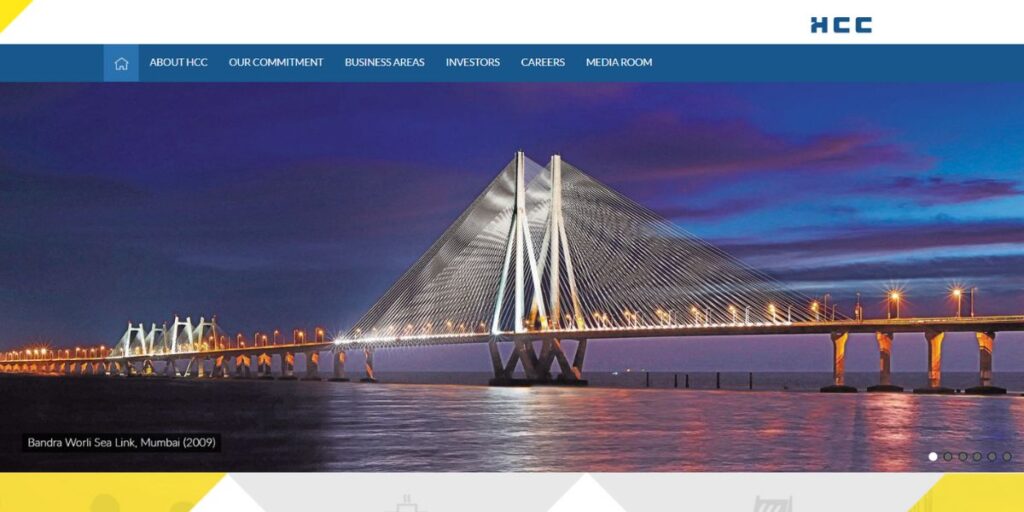
3. Hindustan Construction Company (HCC)
- Revenue: ~₹10,500 Crore
- Key Projects: Bandra-Worli Sea Link, Kudankulam Nuclear Power Plant structures, Bogibeel Bridge, and the Indore Metro underground corridor JV.
- Employees: ~3,000+ (core corporate and engineering staff)
- Services Offered: Transportation infrastructure, hydroelectric projects, nuclear facilities, water solutions, marine construction, and industrial buildings.
- Headquarters: Mumbai, Maharashtra
- Established: 1926
- Website: www.hccindia.com
Being almost a century-old, HCC has been the first of its kind to introduce many innovations into the sphere of constructions and to remain among the most successful infrastructure developers. Throughout its glorious history, the company has been regularly delivering the projects which have become landmarks of Indian infrastructure, and they left an imprint in the life of the country. With an impressive degree of flexibility and technical prowess, HCC has served the hydroelectric and transportation infrastructure complex engineering initiatives.
Managed to develop a reputation of a company performing work under difficult conditions at high quality and safety standards. Their works in the infrastructural development of India feature the most famous familiar structures and installations, which remain valuable to India many decades after their completion, indicating the resilience and the level of expert engineering systems of their houses.
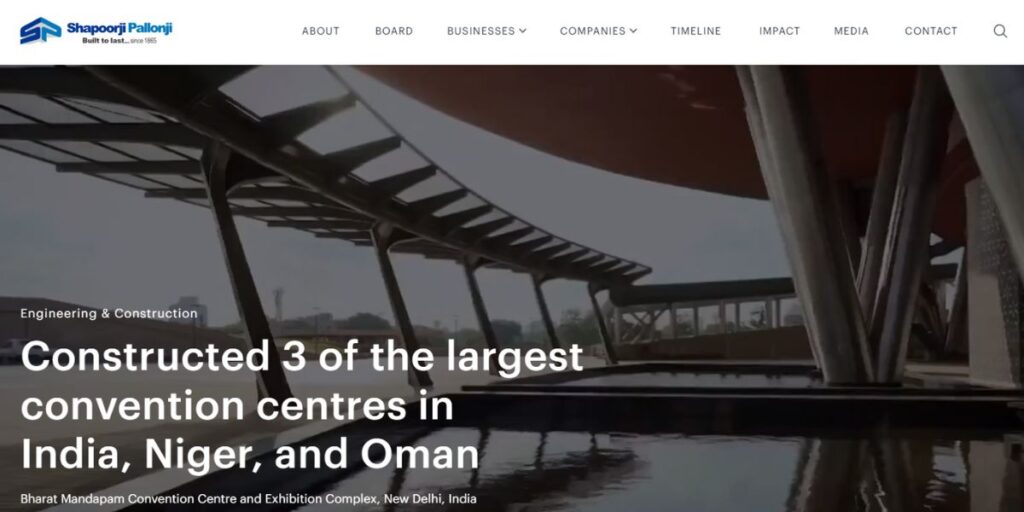
4. Shapoorji Pallonji & Co. Ltd.
- Revenue: ~₹32,000 Crore
- Key Projects: Atal Tunnel structural components, Imperial Towers (Mumbai), IT Parks across Bangalore, and multiple capital city governance buildings.
- Employees: ~45,000+
- HQ: Mumbai, Maharashtra
- Services Offered: High-rise buildings, industrial complexes, infrastructure projects, water treatment plants, and specialty construction.
- Established: 1865
- Website: www.shapoorjipallonji.com
Shapoorji Pallonji is one of the oldest and reliable construction companies in India with more than 150 years of experience in providing World-class infrastructure projects. The company is a household name with respect to quality and innovation in its great history. Having gone through generations, the organization remains an adaptable entity in responding to the shifts in technologies and market needs at the same time preserving its principal organizational values of excellence and integrity.
As one of the prominent Infrastructure Companies in India, Shapoorji Pallonji has also provided structural development to the architectural setting of India with several such projects as buildings which eventually become a symbol of their strength in engineering. Its established reputation of being dependable and of high quality has seen the company emerge as a favorite collaborator in high-status projects in many industries.
5. GMR Infrastructure

- Revenue: ~₹4,200 Crore
- Key Projects: Indira Gandhi International Airport (Delhi) expansion, Hyderabad International Airport development, Bhogapuram Greenfield Airport, and international terminals in Greece and Indonesia.
- Employees: ~7,000+
- HQ: New Delhi
- Services Offered: Airport development and operations, highway construction, energy projects, urban infrastructure, and transportation systems.
- Established: 1978
- Website: www.gmrinfra.com
GMR Infrastructure has become an influential player in the Indian infrastructure sector and has a major experience in the airports and highways as well as energy related projects. They play on both the global and the local market having roots in the Indian market with strategic alliances and investments. The wide portfolio of GMR comprises some of the most luxurious infrastructure assets in India which reflects their ability and capacity to undertake very large and complex developments.
The organization has had the success of evolving into the overall solutions provider as compared to being the traditional infrastructure company, with the lean towards the advanced technologies, and innovations financing models. This has made GMR a reliable company in various countries through its excellence in operations and customer satisfaction.
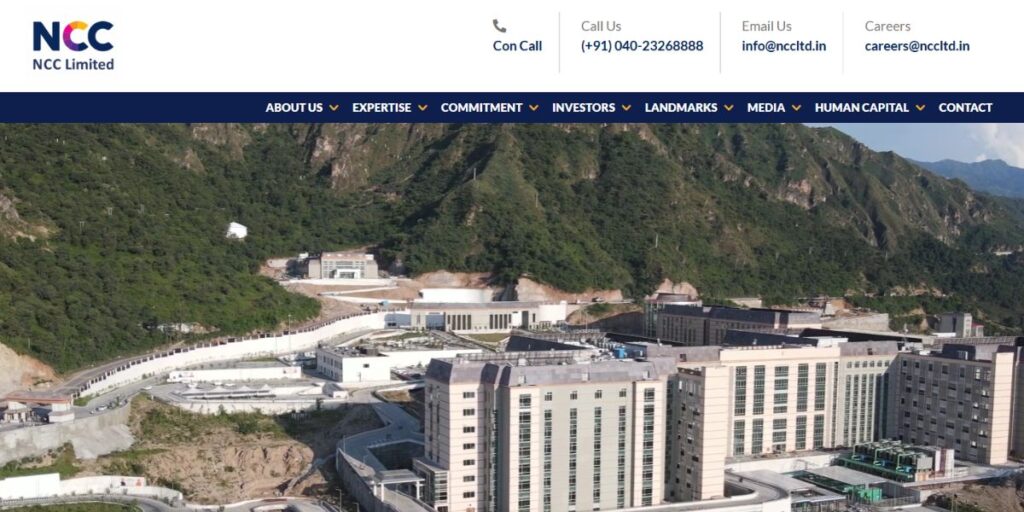
6. NCC Limited
- Revenue: ~₹21,000 Crore
- Key Projects: Sections of the Nagpur-Mumbai Samruddhi Mahamarg, AIIMS structural packages, and major urban water lift supply networks across Telangana and Andhra Pradesh.
- Employees: ~6,500+
- Services Offered: Buildings, transportation infrastructure, water supply systems, power projects, and industrial construction.
- Headquarters: Hyderabad, Telangana
- Established: 1978
- Website: www.nccltd.in
NCC Limited is considered one of the most successful construction and infrastructure groups in India with an impressive record in the accomplishment of elaborate projects in a variety of areas. The company commits itself to sustainable development activities at a level that is highly competitive. Among the leading Infrastructure Companies in India, NCC has a solid reputation of security and technical knowledge among its customers and stakeholders as a powerful firm with a great deal of experience related to various infrastructure sectors.
Innovation and efficiency are valued in the operations of the organization, which constantly implements new methods and technologies in its work to provide a higher input into the results of the project. The idea of being a responsible corporate citizen of the country has led NCC to be a greener corporate citizen, adding to the sustainable development of infrastructure of India besides, generating value to all its stakeholders by observing the concept of being a good corporate citizen in terms of environmental stewardship and community development.
7. Reliance Infrastructure

- Revenue: ~₹22,000 Crore
- Key Projects: Mumbai Metro Line 1 (Versova-Andheri-Ghatkopar), Delhi Airport Metro Express, and multiple toll-road assets across National Highway corridors.
- Employees: ~5,000+
- Services Offered: Transportation systems, metro rail projects, airports, power infrastructure, and urban development.
- Headquarters: Mumbai, Maharashtra
- Established: 1929
- Website: www.rinfra.com
NCC Limited is considered one of the most successful construction and infrastructure groups in India with an impressive record in the accomplishment of elaborate projects in a variety of areas. The company commits itself to sustainable development activities at a level that is highly competitive. NCC has a solid reputation of security and technical knowledge among its customers and stakeholders as a powerful firm with a great deal of experience related to various infrastructure sectors.
Innovation and efficiency are valued in the operations of the organization, which constantly implements new methods and technologies in its work to provide a higher input into the results of the project. The idea of being a responsible corporate citizen of the country has led NCC to be a greener corporate citizen, adding to the sustainable development of infrastructure of India besides, generating value to all its stakeholders by observing the concept of being a good corporate citizen in terms of environmental stewardship and community development.
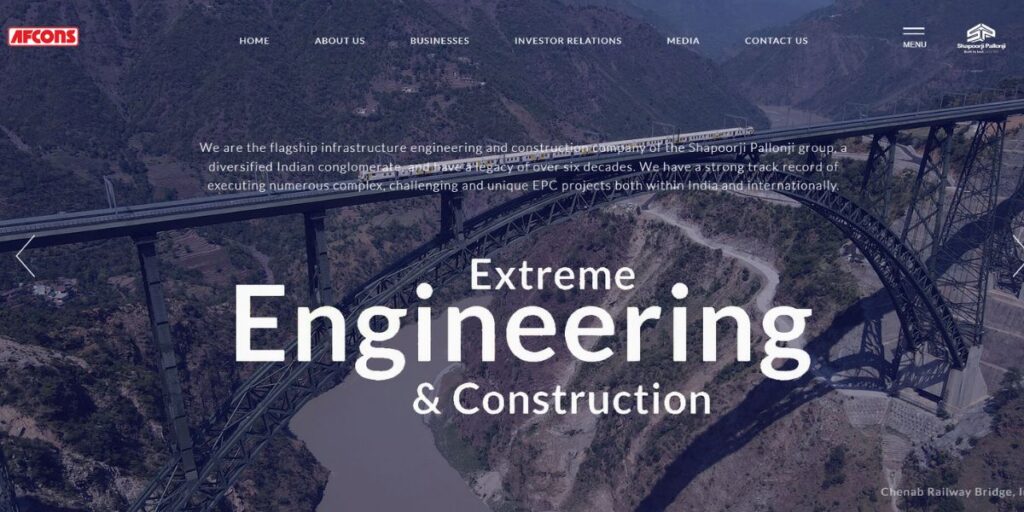
8. Afcons Infrastructure
- Revenue: ~₹13,500 Crore
- Key Projects: Chenab Rail Bridge (JV), Atal Tunnel engineering, Kolkata Metro Underwater Tunneling (East-West Corridor), and the Mumbai-Ahmedabad Marine Bullet Train portal.
- Employees: ~8,000+
- Services Offered: Roads and highways, bridges, tunnels, marine structures, airports, and industrial projects.
- Headquarters: Mumbai, Maharashtra
- Established: 1959
- Website: www.afcons.com
Afcons infrastructure has already established itself as a Company that is capable of delivering tough infrastructure assignments especially in complex terrains and a complex environment. The company focuses on transport and marine infrastructure, which has proved to possess extraordinary technical skills when operating under extreme conditions. Afcons has had decades of experience in delivering large and complex engineering jobs, and has culled out special competencies that makes it unique in the infrastructure sector.
Dedication to safety and quality of the organization has made it able to successfully complete projects, in geographical/environmental unfavourable circumstances. Afcons has gone to the frontiers to develop its capabilities in engineering excellence where other builders will never even dare to engage in such aspects thus building the infrastructure backbones of India in harsh and remote places.
9. IRB Infrastructure Developers
- Revenue: ~₹9,000 Crore
- Key Projects: Mumbai-Pune Expressway widening and long-term toll asset management, Chittorgarh-Gulabpura Highway, and multiple NHAI Hybrid Annuity Model (HAM) corridors.
- Employees: ~4,000+
- Services Offered: Highway construction, expressways, bridges, tollway operations, and infrastructure development.
- Headquarters: Mumbai, Maharashtra
- Established: 1998
- Website: www.irbinfra.com
IRB infrastructure developers are the best highway developers in India and excel in the development of build-operate-transfer (BOT) projects. Innovative execution and financing models have given the company a fair share in contributing to the development of the highway network in India. Among the top Infrastructure Companies in India, The expertise that IRB has acquired and built in this particular aspect of infrastructure (highways) means that the company is being sought when public bodies undertake highway development projects.
The history of successful performance of the organization in the BOT projects indicates that the company can handle complicated financial models and provide quality infrastructure. The role played by IRB to enhance the connectivity in India has had a good impact on the development of the economy and the integration of the regions, as the government has envisioned the integrated transportation system of the entire country.
10. JMC Projects (India) Ltd.
- Revenue: ~₹19,500 Crore
- Key Projects: Kanpur Metro structural corridors, multi-layered flyovers in Bengaluru, and major high-voltage power transmission grids across Africa and South Asia.
- Employees: ~9,000+
- Services Offered: Civil construction, industrial projects, metro systems, highways, commercial buildings, and infrastructure development.
- Headquarters: Mumbai, Maharashtra
- Established: 1986
- Website: www.jmcprojects.com
JMC Projects is one of the well-posed civil infrastructure corporations that specializes in the implementation of sophisticated construction projects. Their adaptation and growth has enabled them to diversify their portfolio to venture in different infrastructure sectors which has made them competitive in already existing markets. Having established a proven track record in civil construction, JMC has posed its services to address urban needs and the scope of work has modern infrastructure needs such as metro systems and urban development work.
Adherence to quality and timely delivery has made the organization gain recognition in the eyes of the clients and whoever it is in the industry. JMC has transformed with the fluctuating market needs and integrated innovative technologies and sustainable operations into it, with its foundations still in the field of construction quality and project management.
Emerging Infrastructure Companies in India to Watch in 2026
The market features highly agile, mid-cap execution engines gaining immense order traction:
- H.G. Infra Engineering Ltd: These structural engineers are growing fast in the highway segment, and moving towards constructing complex railways structures, achieving an impressive asset monetization ratio.
- PSP Projects Ltd: Institutional building leader with an excellent track record in completing high-profile government campuses/corporate industrial parks well ahead of schedule.
- G R Infraprojects Ltd: Highly renowned for structural backward integration, where they manufacture some of the key components for executing their contracts without margin risks.
- Techno Electric & Engineering Co. Ltd: One of the best mid-cap utility companies getting massive traction with a niche focus on data centers, green energy plants, and smart metering technology.
- Ashoka Buildcon Ltd: Proven to have impressive balance sheet resilience after winning several HAM highway expansion projects and aggressively disposing of older ones to create execution capital.
Sector-Wise Project Breakdown
The core infrastructure fields are distributed across distinct, specialized asset classes as mapped below.
| Sub-Sector | Core Focus & Strategic Priorities | Major Listed & Non-Listed Players |
| Roads & Highways | Expanding National Highways at an aggressive rate exceeding 35 km/day; deploying expressways. | IRB Infra, Ashoka Buildcon, H.G. Infra, G R Infraprojects |
| Railways & Metro | Complete station modernizations, Dedicated Freight Corridors (DFCs), and city-wide mass transit lines. | RVNL, Ircon International, L&T, Tata Projects |
| Power & Utilities | Ultra-mega solar parks, green hydrogen logistics, HVDC distribution lines, and national smart metering. | Adani Green, NTPC, Techno Electric, KEC International |
| Airport & Aviation | Execution of Greenfield hub frameworks alongside modernization of Tier-2 and Tier-3 cities. | GMR Airports, L&T, Tata Projects |
| Smart Cities | Integrated Command & Control Centers (ICCC), urban automated transit, and integrated water networks. | NBCC, L&T, NCC Ltd, Kalpataru Projects |
Growth Drivers of the Indian Infrastructure Sector
Government Initiatives: The National Infrastructure Pipeline (NIP) and other flagship schemes such as Bharatmala, Sagarmala and Smart Cities Mission have opened up unseen potentials of the infrastructure industry in India. Such efforts yield comprehensive policy guidance and hefty budgetary investment that facilitate the expansion of sectors.
Urbanization: The very high rate of urbanization in India, where more than 40 percent of the population is estimated to be urbanized by the year 2030, presents insurmountable demand on urban infrastructure. Such a change of demography demands large-scale investments in housing, transportation, utilities as well as social infrastructure.
Economic Growth: India is one of the fastest-growing major economies of the world, which explains the need of infrastructure in every industry. The increased income levels, altered consumption patterns and industrial growth leads to long-term demand of infrastructure.
Foreign Investment: Higher foreign direct investment in infrastructural projects introduces high technology, international best practice, and other capital. The international alliances assist the Indian firms to explore new markets and increase their technical competence.
Technology Advancement: Infrastructure development is changing, with digital transformation, artificial intelligence and new construction technologies transforming how infrastructure is planned and built. Such innovations permit more effective realizations in terms of project, improved management of assets, and sustainable development approaches.
Climate Goals: Renewable energy, green buildings and sustainable infrastructure investment are supplied by the interest of India to accomplish net-zero emissions by 2070. The shift opens up new markets to firms in the clean technology and environmental solutions market segments.
Government Initiatives Driving India Infrastructure Growth
Key government-led initiatives propelling the architectural and logistical shift forward:
- National Infrastructure Pipeline (NIP): This is a critical policy framework which creates macro-level visibility of about 14,500 infrastructure projects worth ₹213 trillion in terms of expenditure.
- PM Gati Shakti National Master Plan: Makes use of a state-of-the-art GIS technology that ensures seamless coordination and integration of all clearances from 17 ministries.
- Smart Cities Mission & Urban Transformation: A major focus on regional development of metropolitan hubs as economic zones through command center-based governance platforms (ICCC).
- Unified Logistics Interface Platform (ULIP): This integration integrates all data pipelines for nationwide transportation through a single portal where shipping, rail cargo, and customs clearance can be monitored in real-time by private logistics companies.
- Sovereign Green Bonds & Climate Finance: The green focus of the Union Budget is used to raise environmental funds to rapidly reduce interest rates on sustainable grids, mass EV charging stations, and wind-solar hybrid corridors.
India’s Global Infrastructure Footprint
International Expansion: India, major infrastructure corporations have been able to spread their presence to other countries of the globe implementing projects in Africa, Middle East, and Southeast Asia among other places. Their international network improves their technical capacities and penetrate markets better.
Technology Transfer: Indian companies are also getting more and more into the position of technology providers rather than being mere service providers and they are exporting Indian engineering solutions as well as Indian methods of construction to the global markets. This metamorphosis makes India one of the world centers of infrastructure.
Strategic Partnerships: Joint products with best practices in the world, technological moves and the availability of new market is offered through collaborating with international firms. Such joint ventures improve the competitiveness of Indian enterprises in the international infrastructure implication.
Development Finance: The Indian companies are getting involved in multilateral development programs sponsored by agencies such as WORLDBANK, Asian Development Bank and bilateral development agencies. These projects expose one to the international standards and practices.
Skill Export: India has a large population of highly qualified engineers and other project and construction specialists who are engaging in international work and are therefore helping to pave the infrastructure across the world not to mention that they acquire good knowledge and experience.
Investment Opportunities: The companies in Indian infrastructure industry are getting external investments besides joint venturing with international players. The access to capital along with technology and international markets and enhancement of infrastructure capabilities of India are also the advantages of such partnerships.
Challenges Faced by Infrastructure Companies
- Regulatory Complexity: The complexities in the infrastructure business development environment in India include, dealing with various government agencies and environmental approvals and compliance levels. Such processes lead to project delay and add much of the project expenses.
- Land Acquisition: The most difficult aspect in undertaking an infrastructural project is acquisition of land which takes a very long time, settlements has to be handled and communities supported back to their feet which is quite cumbersome. These are some of the issues which can cause significant delays to the implementation of the projects.
- Financing Constraints: Frequently, projects of large infrastructure development consume a lot of capital and firms may experience difficulties in ensuring sufficient funding under decent terms. This is especially difficult in smaller firms and new entrants.
- Skill Shortage: Even though India has a big workforce, it faces shortage of competent workforce in the niche fields such as project management, construction high-end technology, and environmental compliance. This is a disparity, which interferes with project quality and schedules.
- Technology Adoption: Although technology has the capability of increasing efficiency and quality, most firms find it difficult to adopt new technologies in terms of costs, training needs and reluctance to leave old ways of doing things.
- Market Competition: The high competition among the firms in the infrastructure sector contributes to a high and tough competition, low margins and demands to go to work on projects with the fewest possible resources. This situation may deteriorate quality and profitability.
Future Outlook: Infrastructure in India by 2030
Digital Integration: Digital technology Infrastructure companies in India will become more integrated with digital technologies such as artificial intelligence, machine learning and Internet of Things (IoT). These technologies will enhance the efficiency of the projects, management of the assets, and predictive maintenance.
Sustainable Development: Sustainability will be the major issue, and businesses are going to embrace green construction, clean energy technologies, and circular economy approaches. The movement will open up new market segments and competitive advantage.
Smart Infrastructure: The construction of smart cities, intelligent transport systems, and interconnected infrastructure will increase the demand of technology enabled solutions. Enterprises will have to master the skills of integration of smart systems and data analytics.
Public-Private Partnerships: Through the enhanced cooperation of the government and the private sector, new sources of financing and delivery options will be achieved within the project. Such collaborations will allow the more effective use of resources and sharing risks.
Regional Expansion: Development of infrastructure will not only be limited to big cities but also it will extend to the tier-2 and tier-3 cities, rural and border areas. This growth will open up new horizons with new demands and needs.
Global Competitiveness: The Indian infrastructure firms will get better market position in the international market as the key players in the international infrastructure development. The growth will demand more project finance, technology and cross-cultural management skills.
Conclusion
The infrastructure playfield of the India businesses is fast growing, with big government programs, technology and aspirations of the country. These bodies have proven to be very strong and flexible and have overcome hurdles with ease and completed some of the best infrastructural development projects in the world that contribute towards the development objectives of India.
With Future Evolutions, the infrastructure companies in India have a good opportunity to enjoy the new prospects that await in terms of sustainable development, smart infrastructure, and digital transformation. The future prosperity of the sector will be determined by the companies willingness to innovate, build up the skilled workforce, and be financially stable to carry out more complex projects.
The contribution of the infrastructure sector to the economic growth of India is much more than laying of the structures and buildings, generating employment, enhancing the industrial base, and creating a better quality of life to millions of Indians. In further travel towards being a developed country, infrastructure companies in India are becoming more critical towards the development of the country and what role India will play in the world as an infrastructure juggernaut.
Also Read:
FAQs
Which is the biggest infrastructure company in India?
Larsen & Toubro Ltd (L&T) is comfortably the biggest infrastructure company in India, holding an incredible annual consolidated revenue stream of ₹2.85 lakh crores, along with record-high order book of ₹7.40 lakh crore as of 2026.
What is the market size of Indian infrastructure?
The market size of India’s infrastructure sector industry stands at $205.96 billion in 2026 and is expected to grow strongly to reach $302.62 billion by 2031 at a CAGR of 8% p.a.
What are the top government-owned infrastructure firms in India?
Some of the most prominent PSUs in the infrastructure sector are Rail Vikas Nigam Limited (RVNL) for mass transit railway projects, Ircon International for specialized geographic projects, and NBCC (India) Ltd for institutional civil construction.
What is the National Infrastructure Pipeline (NIP)?
The National Infrastructure Pipeline refers to a master policy which covers over 14,500 projects across India with a comprehensive investment blueprint of ₹213 trillion.
Which Indian infrastructure companies are good for investing in the stock market?
Top blue chip firms such as Larsen & Toubro offer stability and diversification, while companies like RVNL offer high growth from railway allocations, and IRB Infrastructure developers offer strong toll-cash flow.
What is PM Gati Shakti and how does it help infrastructure firms?
The PM Gati Shakti is a master plan using GIS structural mapping to coordinate between 17 ministries. It helps engineering contractors save huge sums of money in logistics costs and regulatory delays.