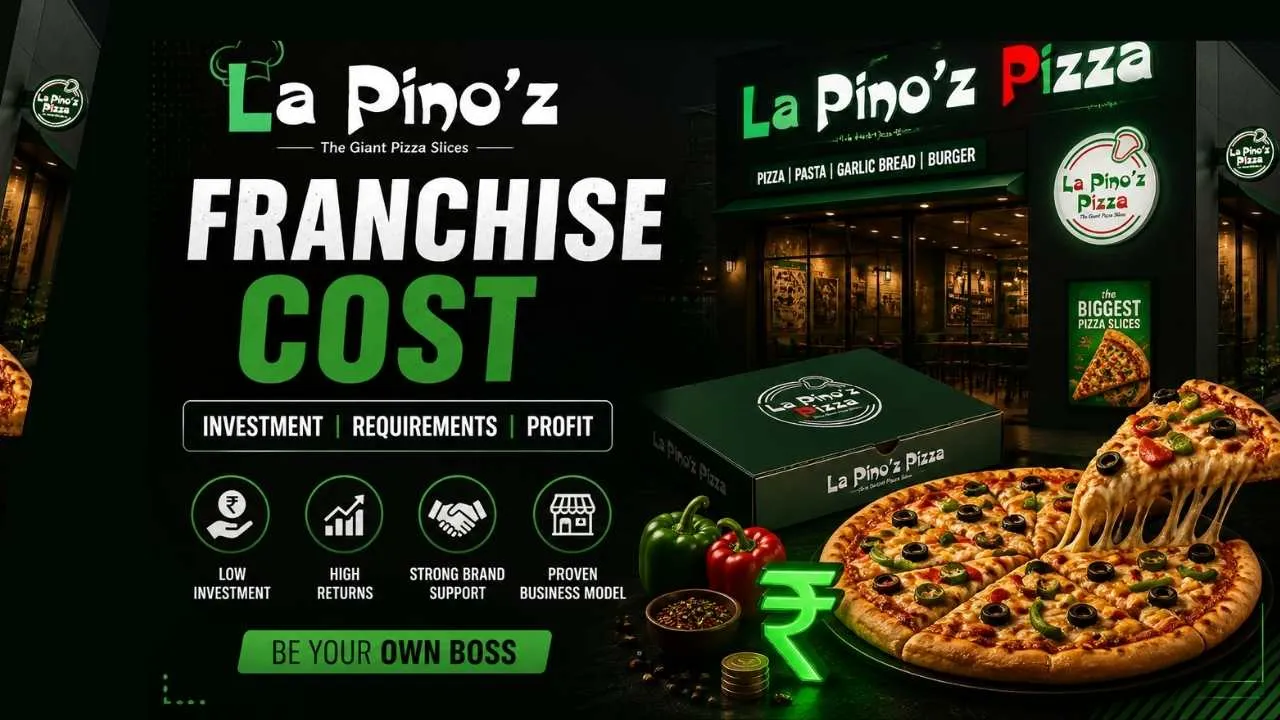
India’s pizza market has crossed a significant milestone — valued at approximately USD 1.76 billion at the close of 2024 and projected to reach USD 3.65 billion by 2029 at a CAGR of 15.65%. Within this expanding landscape, La Pino’z Pizza has emerged as one of the most compelling franchise opportunities available to Indian entrepreneurs in 2026.
The brand crossed 750 operational outlets across India in mid-2026 and is now aggressively targeting the 1,000-outlet milestone. If you are researching the La Pino’z franchise cost in 2026, this guide gives you the complete picture: current investment figures, outlet models, profit benchmarks, legal requirements, and a step-by-step application process.
2026 Quick Snapshot: Total Investment: ₹25 lakh – ₹1 crore (format-dependent) | Franchise Fee: ₹9.9 lakh | Royalty: 4% of monthly sales | Breakeven: 12–18 months | Agreement: Lifetime | Outlets (2026): 750+ and growing
About La Pino’z Pizza: From One Outlet to 750+
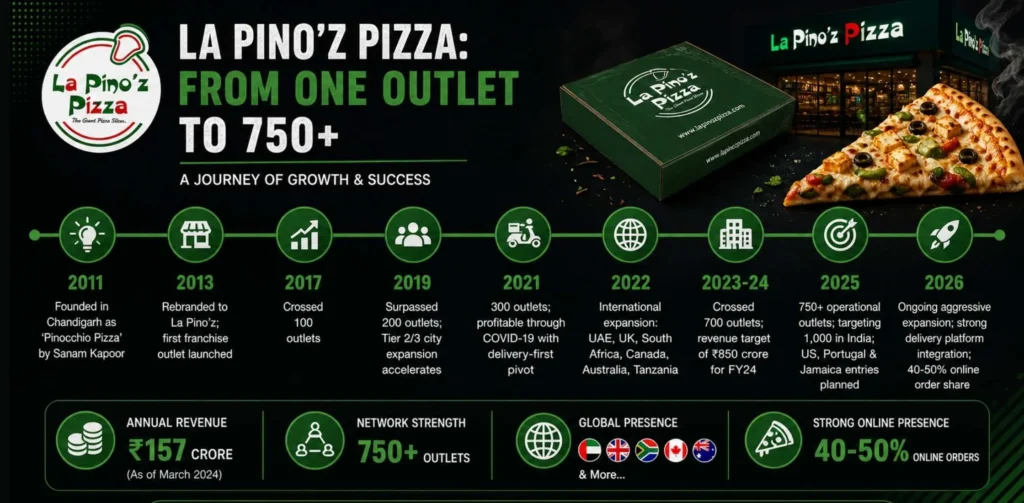
La Pino’z Pizza was founded in 2011 in Chandigarh by Sanam Kapoor, initially under the name ‘Pinocchio Pizza.’ The brand’s original USP was straightforward but disruptive: giant pizza slices sold by the piece. In a market conditioned to order whole pizzas, this was a novel proposition that immediately resonated with students and young professionals.
The brand was rebranded to La Pino’z in 2013 and launched franchising the same year. What followed was one of the fastest expansions in Indian QSR history.
| Year | Milestone |
|---|---|
| 2011 | Founded in Chandigarh as ‘Pinocchio Pizza’ by Sanam Kapoor |
| 2013 | Rebranded to La Pino’z; first franchise outlet launched |
| 2017 | Crossed 100 outlets across India |
| 2019 | Surpassed 200 outlets; Tier 2/3 city expansion accelerates |
| 2021 | 300 outlets; profitable through COVID-19 with delivery-first pivot |
| 2022 | International expansion: UAE, UK, South Africa, Canada, Australia, Tanzania |
| 2023–24 | Crossed 700 outlets; revenue target of ₹850 crore for FY24 |
| 2025 | 750+ operational outlets; targeting 1,000 in India; US, Portugal & Jamaica entries planned |
| 2026 | Ongoing aggressive expansion; strong delivery platform integration; 40–50% online order share |
Under Copenhagen Hospitality Private Limited, the holding company, La Pino’z reported annual revenue of approximately ₹157 crore (as of March 2024) from corporate operations, with total network revenue — including franchise outlets — significantly higher. The brand’s competitive positioning rests on three pillars: generous portion sizes, Indianised flavour profiles (paneer tikka, peri-peri chicken, achari murg), and pricing that undercuts global rivals by 15–25% on comparable products.
Why Invest in a La Pino’z Franchise in 2026?
1. Delivery-First Brand in a Delivery-First Market
Online food delivery in India grew from ₹15,000 crore in 2020 to over ₹45,000 crore by 2024. La Pino’z has deeply integrated with Swiggy, Zomato, and its own uEngage-powered app, with online orders now accounting for 40–50% of weekday revenues per outlet. This reduces dependence on walk-in footfall and creates a stable revenue floor from day one.
2. Strong Tier-2 and Tier-3 Penetration
While global pizza franchise opportunities in India brands concentrated in metros, La Pino’z made early inroads into cities like Bhopal, Indore, Surat, Ludhiana, and Jaipur. This first-mover advantage in emerging urban centres means less competition and faster brand recall for new franchisees in these markets.
3. Proven Margins in a Growing Category
India’s pizza segment is growing at 12% annually, driven by rising urban incomes (15% increase in disposable income recorded in 2024), an urban population now at 34% of total, and a youth demographic where 3 in 4 QSR purchases are made by customers under 35.
4. Lifetime Franchise Agreement
Unlike global brands that offer 5–10 year franchise terms, La Pino’z provides a lifetime agreement, removing the anxiety of renewal negotiations and protecting your long-term investment.
5. One of the Lowest Royalty Rates in QSR Pizza
At 4% of monthly gross sales, La Pino’z’s royalty is significantly below Domino’s (5.5%) and Pizza Hut (6%), directly improving net margins for franchisees.
La Pino’z Franchise Models in 2026
La Pino’z offers three outlet formats designed to suit different capital levels and location types. Choose based on your available investment, preferred city tier, and operational capacity.
| Feature | Kiosk / Express | Takeout & Delivery (1600 Series) | Dine-in Restaurant |
|---|---|---|---|
| Franchise Fee | ₹9.9 lakh | ₹9.9 lakh | ₹9.9 lakh |
| Total Investment (2026) | ₹20 lakh – ₹30 lakh | ₹40 lakh – ₹60 lakh | ₹65 lakh – ₹1 crore |
| Space Required | 200–400 sq. ft. | 600–1,000 sq. ft. | 1,000–1,500 sq. ft. |
| Ideal Location | Food courts, campuses, transit hubs | Residential areas, colleges, offices | High streets, malls, commercial hubs |
| Monthly Royalty | 4% of sales | 4% of sales | 4% of sales |
| Working Capital | ₹3–5 lakh | ₹5–8 lakh | ₹6–8 lakh |
| Agreement Term | Lifetime | Lifetime | Lifetime |
| Seating | None | Minimal / none | Full dining area |
| Monthly Revenue (Avg.) | ₹3–6 lakh | ₹6–12 lakh | ₹10–20 lakh |
2026 Recommendation: For first-time investors, the Takeout & Delivery model offers the best balance: manageable capital outlay, low operational complexity, and strong delivery revenue from day one. Outlets near colleges, IT parks, and densely populated residential areas typically recover their investment in 12–15 months.
La Pino’z Franchise Cost 2026: Complete Investment Breakdown
Investment figures have been updated to reflect 2026 market conditions, including higher real estate costs in metros and increased equipment costs post-inflation. Use the table below for your financial planning.
| Cost Component | 2026 Investment Range | Details |
|---|---|---|
| Franchise Fee | ₹9.9 lakh (one-time) | Brand licence, proprietary recipes, training access, and operational systems |
| Store Interiors & Branding | ₹8 lakh – ₹35 lakh | Interior design per brand standards, signage, counters, seating (if dine-in), civil work |
| Kitchen Equipment | ₹6 lakh – ₹20 lakh | Pizza ovens, dough mixers, refrigeration, prep tables, exhaust systems, POS |
| Initial Raw Material & Inventory | ₹2 lakh – ₹5 lakh | Cheese, sauces, dough ingredients, vegetables, packaging — sufficient for 4–6 weeks |
| Working Capital Reserve | ₹5 lakh – ₹8 lakh | 3 months of salaries, rent, utilities — mandatory buffer during ramp-up |
| Licences & Regulatory Compliance | ₹50,000 – ₹1.5 lakh | FSSAI, GST, fire NOC, trade licence, eating house permit (varies by state) |
| Technology Setup | ₹50,000 – ₹1 lakh | POS integration, Swiggy/Zomato onboarding, CCTV, billing systems |
| Launch Marketing | ₹50,000 – ₹2 lakh | Grand opening campaigns, local social media, flyer distribution, offers |
| Royalty (Ongoing) | 4% of monthly gross sales | Paid monthly to La Pino’z corporate; one of the lowest rates in QSR pizza |
| Total — Kiosk Format | ₹20 lakh – ₹30 lakh | Best entry point for new investors; delivery-focused |
| Total — Delivery Outlet | ₹40 lakh – ₹60 lakh | Most popular format; strong delivery + takeout revenue mix |
| Total — Dine-in Restaurant | ₹65 lakh – ₹1 crore | Highest revenue ceiling; suited for prime locations |
City-wise Investment Variation (2026)
Location significantly affects your total cost, particularly rent and interior spend:
- Tier-1 cities (Delhi, Mumbai, Bengaluru, Hyderabad, Pune): Add 25–35% to base estimates, driven by higher commercial real estate rates post-2024.
- Tier-2 cities (Jaipur, Lucknow, Indore, Surat, Chandigarh): Mid-range estimates are largely accurate.
- Tier-3 and smaller cities: Setup costs can be 15–20% below mid-range, but demand validation before signing is essential.
Licences and Legal Requirements
This step is chronically underestimated by first-time franchise investors. Start regulatory filings at least 8–10 weeks before your planned launch date. The following are mandatory:
| Licence / Document | Issuing Authority | Approx. Cost & Timeline |
|---|---|---|
| FSSAI Food Business Licence | Food Safety & Standards Authority of India | ₹5,000–10,000 | 2–4 weeks |
| GST Registration | GST Council | Free | 3–7 working days |
| Trade Licence / Shop & Establishment Act | Local Municipal Corporation | ₹2,000–10,000 | 1–3 weeks |
| Fire NOC | State Fire Department | ₹5,000–20,000 | 2–6 weeks |
| Eating House Licence | Local Police Commissioner (state-specific) | ₹1,000–5,000 | 2–4 weeks |
| Udyam / MSME Registration | Ministry of MSME | Free | 1–3 days |
| PAN & Business Bank Account | Income Tax Dept / Bank | Minimal | 3–5 days |
La Pino’z provides a documentation checklist and guidance, but filings are the franchisee’s responsibility. Budget ₹50,000–1.5 lakh total for all regulatory costs.
Profit Margins and ROI: 2026 Benchmarks
Revenue Benchmarks by Outlet Type
| Outlet Type | Monthly Revenue (Avg.) | Annual Revenue (Avg.) | Net Profit Margin | Monthly Net Profit |
|---|---|---|---|---|
| Kiosk / Express | ₹3 lakh – ₹6 lakh | ₹36 lakh – ₹72 lakh | 15–20% | ₹45,000 – ₹1.2 lakh |
| Takeout & Delivery | ₹6 lakh – ₹12 lakh | ₹72 lakh – ₹1.44 crore | 20–27% | ₹1.5 lakh – ₹3 lakh |
| Dine-in Restaurant | ₹10 lakh – ₹20 lakh | ₹1.2 crore – ₹2.4 crore | 15–22% | ₹2 lakh – ₹4.4 lakh |
ROI Summary Table
| Parameter | 2026 Estimate |
|---|---|
| Gross Profit Margin | 55–65% (food cost vs. selling price) |
| Net Profit Margin | 15–27% after rent, staff, royalty, utilities |
| Breakeven Point | 12–18 months for well-located outlets (some in 10–12 months) |
| Annual ROI (post-breakeven) | 30–40% |
| Ongoing Royalty | 4% of gross monthly sales |
| Annual Revenue Per Outlet | ₹80 lakh – ₹2 crore depending on format and location |
Key Profit Drivers in 2026
- Online delivery mix: Outlets with 50%+ delivery share have lower per-order operational cost. Festivals and IPL season see revenue spikes of 25–40%.
- Upselling: Combos, shakes, and add-ons increase average ticket size by ₹80–150 per order.
- Location quality: Outlets near colleges and IT parks outperform standard high-street locations by 30–40% in monthly revenue.
- Operational efficiency: Franchisees who track daily MIS (sales, bakery & food franchise cost, wastage) consistently achieve margins at the upper end of the range.
- Staff retention: Reducing annual turnover from the QSR average of 50–60% saves ₹1.5–2 lakh per year in re-training costs.
Training and Ongoing Support
La Pino’z’s franchisor support is one of its strongest competitive differentiators against starting a standalone restaurant. Here is what is included:
| Support Area | What’s Included |
|---|---|
| Pre-opening Training | 3-week intensive at a training outlet: pizza preparation, kitchen ops, inventory management, hygiene, customer service, and POS system use |
| Site Selection | Demographic analysis, competitor mapping, footfall assessment, and rent-to-revenue ratio evaluation for shortlisted locations |
| Interior & Store Design | Brand-standard design templates, approved vendor network, on-site supervision during setup |
| Supply Chain Access | Approved suppliers for proprietary ingredients (dough, cheese blends, sauces) at central procurement pricing — 83% of corporate revenue is raw material supply |
| Technology Integration | POS system setup, Swiggy/Zomato merchant onboarding, uEngage app integration, daily sales dashboard |
| Marketing Support | National digital campaigns, festival promotions, social media content kits, local marketing toolkits, and hyperlocal advertising guidance |
| Ongoing Operations | Regional operations managers conduct periodic visits; helpdesk for day-to-day queries; WhatsApp-based support for urgent issues |
| Menu Updates | New products and seasonal launches are rolled out brand-wide; franchisees receive advance training before launch |
| Grand Opening | A trained chef is deployed to your outlet for the first 1–2 weeks to ensure quality standards and staff training are in place from day one |
How to Apply for a La Pino’z Franchise in 2026: Step-by-Step
Step 1 — Initial Enquiry
Submit a franchise enquiry through the official portal:
- Website: lapinozpizza.in/franchise-enquiry
- Email: [email protected]
- Phone: 8238235444
Provide your city preference, available capital, and business background. The franchise team typically responds within 3–5 working days.
Step 2 — Application & Financial Verification
Submit a detailed application with: bank statements (last 6 months), ITR for 2 years, PAN card, Aadhaar, and a brief business plan. The team assesses your financial capacity and liquidity.
Step 3 — Location Evaluation
Share your shortlisted locations. La Pino’z evaluates footfall data, rent-to-revenue ratios, proximity to competitors, and local demographics. Typical turnaround: 2–4 weeks.
Step 4 — Agreement Signing
Once the location is approved, you receive and sign the lifetime franchise agreement. Review all clauses carefully — particularly territory rights, performance benchmarks, supply chain obligations, and termination conditions. Engaging a franchise lawyer is strongly recommended at this stage.
Step 5 — Setup & Staff Training
Outlet construction begins immediately after signing. Simultaneously, you and key staff attend the 3-week training programme. La Pino’z deploys a head chef to your outlet for the first weeks post-launch to ensure consistent quality.
Step 6 — Soft Launch & Full Operations
After a 2–4 week soft launch with local promotions, the outlet moves to full operations. Swiggy/Zomato listings go live at this stage. Expect your revenue to ramp steadily over the first 60–90 days as reviews and repeat customers build.
Timeline: From initial enquiry to opening day: approximately 60–90 days for a standard outlet, depending on regulatory approvals and property readiness.
Challenges to Anticipate
Intensifying Competition in Delivery
La Pino’z competes not just with Domino’s and Pizza Hut but increasingly with Mojo Pizza, Oven Story, and aggressive local cloud kitchen brands on Zomato. Your listing quality, ratings, and delivery platform offer strategy directly affect revenue in 2026.
Real Estate Costs
Commercial rentals in Tier-1 cities rose significantly in 2024–25. The rent-to-revenue ratio should not exceed 10–12% for a healthy outlet. If projected rent is higher, switch to a delivery-only or kiosk model in that city.
Staff Retention
QSR staff turnover in India averages 50–60% annually. Retaining 2–3 core staff who know your kitchen operations is critical. Budget for ongoing training. Informal perks (meals, flexible shifts, referral bonuses) significantly reduce churn.
Regulatory Lead Times
FSSAI and fire NOC approvals can take 4–6 weeks longer than expected in some states. Starting the process before you’ve signed a lease is not possible, but ensure your lease includes a 90-day grace period before rent commencement.
3-Month Cash Flow Gap
Most outlets take 60–90 days to build a stable customer base. Your working capital reserve must cover at least 3 months of full operating expenses — do not treat this as optional.
La Pino’z vs. Other Pizza Franchises: 2026 Comparison
| Brand | Franchise Fee | Total Investment | Royalty | Breakeven |
|---|---|---|---|---|
| La Pino’z Pizza | ₹9.9 lakh | ₹20 lakh – ₹1 crore | 4% | 12–18 months |
| Domino’s Pizza | ₹5 lakh+ | ₹50 lakh – ₹1 crore+ | 5.5% | 24–36 months |
| Pizza Hut | ₹15 lakh+ | ₹60 lakh – ₹1.5 crore | 6% | 24–36 months |
| Mojo Pizza | ₹5–8 lakh | ₹25 lakh – ₹60 lakh | 5% | 18–24 months |
| Oven Story | ₹8–12 lakh | ₹30 lakh – ₹70 lakh | 5–6% | 18–24 months |
La Pino’z offers the lowest royalty rate (4%) and the fastest breakeven in this peer group — making it especially attractive for first-time investors in Tier-2 and Tier-3 markets where global brands have limited penetration.
Tips to Maximise Your La Pino’z Franchise Success
- Prioritise delivery ratings above all else. A 4.2+ rating on Swiggy/Zomato drives 30–40% more orders than a 3.8 rating on the same street. Respond to every review in the first 3 months.
- Avoid mall locations if margins are tight. Mall rentals are high and revenue often does not compensate. High streets near colleges or residential hubs with lower rent deliver better net margins.
- Run hyperlocal campaigns from Week 1. WhatsApp group promotions in nearby apartment societies and colleges, Instagram Reels targeting your pin code, and Google Business Profile management all drive early traction.
- Track three numbers every day: total revenue, affordable food franchise options cost percentage, and customer count. Outlets that review these daily consistently outperform those that do not.
- Build a ‘loyalty loop’ early. A 20% base of repeat customers can generate 50%+ of your revenue. Combo offers and informal loyalty discounts for regulars are more effective than formal programmes.
- Be present in the outlet for the first 6 months. In QSR, hands-on owner involvement in the first half-year is the single biggest predictor of long-term success.
- Use festive seasons strategically. IPL, Diwali, New Year, and Valentine’s Day can each add 25–40% to monthly revenue if you plan offers and stock 2 weeks in advance.
Best Alternatives of Pizza franchise:
Conclusion
La Pino’z Pizza stands out in 2026 as one of the most accessible and well-supported franchise opportunities in India’s high-growth QSR pizza segment. With investment entry points from ₹20 lakh for a kiosk format, a lifetime franchise agreement, a 4% royalty rate below all major pizza brand peers, and 40–50% of revenue now coming through delivery platforms, the business case is stronger than it was even a year ago.
The brand’s aggressive push toward 1,000 outlets means it is actively onboarding new franchise partners across India and in international markets. Entrepreneurs who enter now benefit from a growing brand network, centralised marketing, and improved unit economics driven by supply chain maturity.
Success still depends on the fundamentals: the right location, consistent quality, proactive management, and disciplined cost control. But for investors who commit to these, La Pino’z presents a realistic path to 30–40% annual ROI post-breakeven within 12–18 months.
To begin your enquiry: visit lapinozpizza.in/franchise-enquiry, email [email protected], or call 8238235444.
Read more: KFC Franchise Cost in India
FAQs
What is the minimum investment to open a La Pino’z franchise in 2026?
The minimum is approximately ₹20–25 lakh for a kiosk/express format, inclusive of the ₹9.9 lakh franchise fee and basic setup. The Takeout & Delivery model (most popular) starts at ₹40 lakh.
What royalty does La Pino’z charge?
4% of monthly gross sales — one of the lowest royalty rates among national pizza franchises in India. There is also an informal marketing contribution; confirm the current structure with the corporate team at the time of application.
How long does it typically take to break even?
12–18 months for a well-located outlet with active management. High-delivery-mix outlets near colleges or IT parks have broken even in 10–12 months. Dine-in outlets in premium locations may take closer to 18–24 months.
Is prior restaurant experience required?
No. La Pino’z provides a comprehensive 3-week training programme. However, business acumen, staff management skills, and the willingness to be hands-on are strongly recommended.
Can I open a cloud kitchen / delivery-only La Pino’z outlet?
Yes. The Takeout & Delivery (1600 Series) and Kiosk formats are both delivery-primary models. La Pino’z actively supports Swiggy and Zomato onboarding from day one.
Can I own multiple La Pino’z outlets?
Yes, subject to performance benchmarks at existing outlets and corporate approval. Multi-unit ownership is permitted and encouraged for experienced operators.
What licences do I need?
FSSAI food business licence, GST registration, trade/shop act licence, fire NOC, and an eating house licence (in applicable states). Budget 6–10 weeks for regulatory clearances.
Is La Pino’z planning international franchise expansion in 2026?
Yes. The brand already operates in the UAE, UK, South Africa, Canada, Australia, and Tanzania. As of 2025–26, preparations are underway to enter the United States, Portugal, and Jamaica. International enquiries can be directed to the corporate franchise team.
What documents do I need to apply?
PAN card, Aadhaar, passport-size photographs, bank statements (last 6 months), income tax returns (last 2 years), educational certificates, property documents or rental agreement for the proposed location, and a brief business plan.