India’s food service market is expanding at a tremendous speed, and business entrepreneurs are keen on finding a profitable opportunity to invest in a business which is backed by a brand. One of the most desirable businesses to venture in 2026 is knowing about the Domino’s Franchise Cost in India, with the aim of getting into the organized food retailing segment. Domino’s Pizza has a commanding 70%+ share in the organized pizza delivery segment of India with exclusive management by Jubilant FoodWorks Limited.
The brand’s offer of enduring returns is supported by its extensive penetration in Tier 1, Tier 2 and Tier 3 cities. From startup expenses and monthly charges to margins and application procedures, this guide will address all essential financial aspects, ensuring that you are well-equipped to make a smart investment decision for 2026.
How did Domino’s start?
Domino’s Pizza started in 1960 after two brothers named Tom and James Monaghan acquired DomiNick’s Pizza in Ypsilanti, Michigan. The company pursued expansion, so they rebranded the business Domino’s.
During 1961, Tom Monaghan acquired his brother James’ ownership stake in the business for a minimal cost of $500. During 1965 he managed to expand Domino’s Pizza to operate three independent stores.
The business expansion prompted Tom to introduce the franchise concept, which enabled other individuals to launch their own Domino’s stores.
Domino’s achieved popularity through its credible guarantee of quick delivery, which offered complete refunds for late pizza deliveries. The strategy established Domino’s position as a quick and reliable pizza brand while building its reputation.
During the early 1980s, Domino’s Pizza reached its position as America’s leading pizza delivery chain while expanding beyond 1,000 outlets.
Why Domino’s?
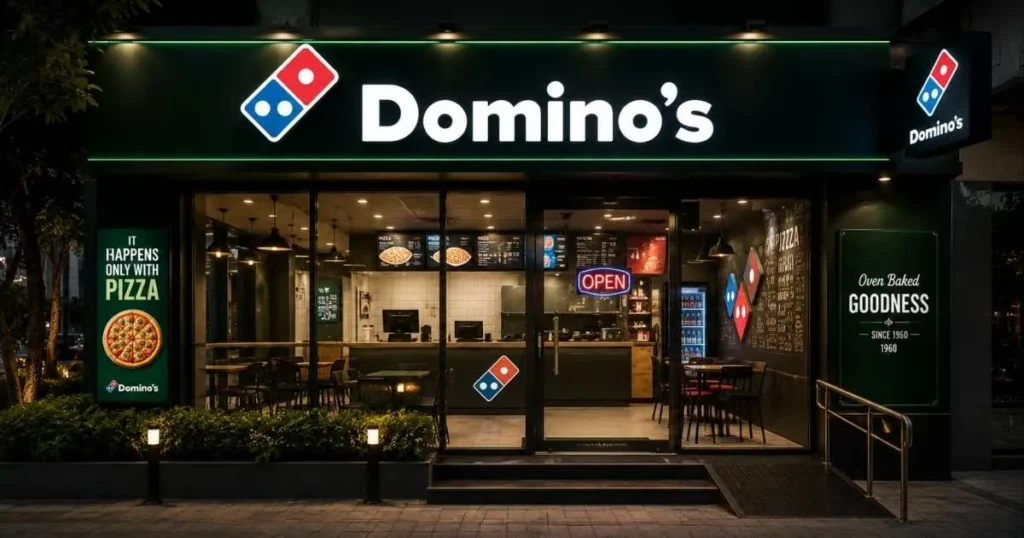
- Market Leadership: Domino’s is the most established brand on the organized pizza delivery market, as it controls the largest market share.
- 30-Minute Delivery System: It is a logistics and delivery system that is extremely optimized and provides outstanding delivery time in the QSR segment.
- Nationwide Brand Trust: Established and known in urban, semi-urban and small towns areas of India and is gaining trust with consistent walk-in and online orders.
- Corporate Support from Jubilant FoodWorks: Jubilant FoodWorks provides complete marketing, operations and supply chain support to the franchisees directly.
- Centralized Supply Chain: Franchise owners can enjoy improved food quality consistency by sourcing ingredients in a standardised way, rather than relying on a single vendor.
- High Digital Order Volume: Their proprietary mobile application, and presence on aggregators, contribute to a large percentage of daily orders.
- Scalable Business Model: There are several options for outlets ranging from the full-size restaurant serving dine-in customers to a small delivery kitchen, and investors with different budgets can participate.
- ROI Track Record: Most operational outlets break even in 3-4 years and have realised an 12-18% profit margin.
India’s QSR Market and Pizza Franchise Opportunity
With rapid urbanisation, an increase in the disposable income of the Indian population and app-based food delivery booming, the Quick Service Restaurant (QSR) sector is poised for strong growth in 2026. Brands and standardisation are gaining popularity among consumers in Tier 2 and Tier 3 cities.
In this environment, the pizza category is one of the fastest-growing food and beverage categories. The Domino’s Franchise Cost in India reveals that the business model is created to tap the consumer shift with accuracy in making a profit. The brand is also pursuing smaller markets, and as a result franchise owners will have continual demand and long-term market growth.
Domino’s Franchise Models
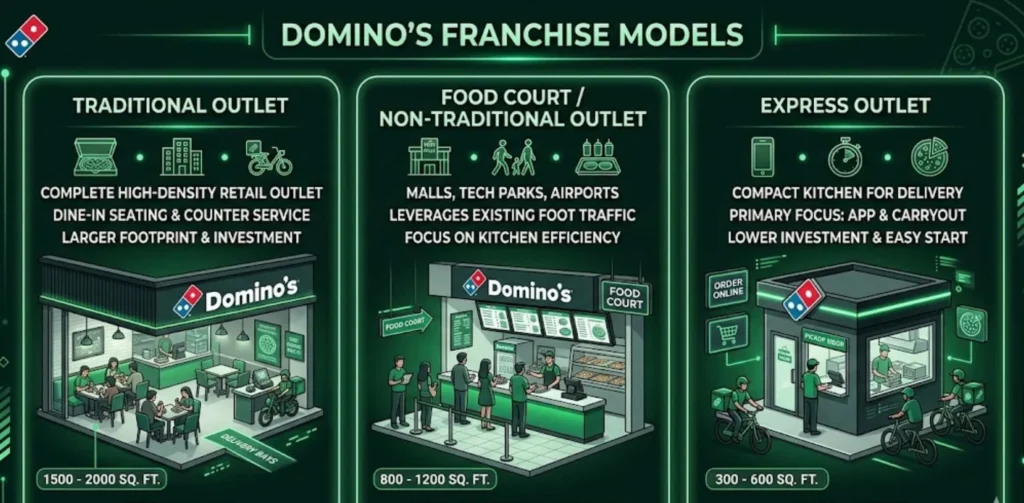
Traditional Outlet
The Traditional Outlet is a complete high-density retail outlet, complete with seating at the front of the store for dine-in. It comes with its own set of 1500 to 2000 sq.ft. of space, providing its own customer seating areas, service counters and delivery bays. It has a significant footprint and civil fit-out requirements making it the most expensive category within the Domino’s portfolio investment.
Food Court / Non-Traditional Outlet
This model is designed for shopping malls, tech parks, airports, and transit hubs, such as those who draw residents from a neighboring community.This model uses existing foot traffic, like shopping malls, tech parks, airports, and transit centers like those that draw residents from a neighboring community. With 800 to 1,200 square feet, it’s more functional with a focus on kitchen efficiency and a speed-of-service approach to counter service than on formal seating. It falls in the middle of the Domino’s Franchise Cost in India investment range and is suitable for commercial places with high traffic.
Express Outlet
Perfect for high traffic, delivery-focused micro-markets, the Express Outlet is a compact kitchen style designed for delivery. Only about 300-600 square feet and nearly all of the business is app and carryout. It’s also much easier on the small investment scale because of its compact footprint, making it the most convenient option for first-time buyers.
Domino’s Franchise Cost in India — Full Investment Breakdown (Model Wise)
To make an informed decision about the Domino’s Franchise Cost in India, it’s crucial to have a clear and model-specific perspective on these distinct capital expenses. All the major cost components are explained in the table below for the three outlet formats.
| Cost Component | Traditional Outlet | Food Court Model | Express Outlet |
| Initial Franchise Fee | Rs. 20L – Rs. 30L | Rs. 15L – Rs. 20L | Rs. 10L – Rs. 15L |
| Kitchen Equipment & Ovens | Rs. 50L – Rs. 70L | Rs. 40L – Rs. 50L | Rs. 30L – Rs. 40L |
| Interior Civil Works & HVAC | Rs. 40L – Rs. 60L | Rs. 25L – Rs. 35L | Rs. 15L – Rs. 20L |
| POS Systems & IT Infrastructure | Rs. 10L – Rs. 15L | Rs. 8L – Rs. 12L | Rs. 5L – Rs. 8L |
| Initial Inventory & Working Capital | Rs. 15L – Rs. 25L | Rs. 10L – Rs. 15L | Rs. 5L – Rs. 10L |
| Total Estimated Investment | Rs. 1.35 Cr – Rs. 2.00 Cr | Rs. 98L – Rs. 1.32 Cr | Rs. 65L – Rs. 93L |
The Domino’s Franchise Cost in India is designed to suit various investment budgets, allowing the brand to expand its reach into different markets while maintaining the quality of its operations.
One-Time vs Recurring Costs — What You Pay Upfront vs Monthly
Aside from the cost of the initial investment, the franchise owner has to take into account the future costs associated with running the business. It’s easy to see a breakdown between the one-time costs and the recurring monthly ones.
| Expense Type | Cost Component | Payment Frequency | Estimated Amount |
| One-Time | Brand Rights / Franchise Fee | Once per 10-year term | Rs. 10L – Rs. 30L (model dependent) |
| One-Time | Store Setup & Core Machinery | At store inception | Rs. 50L – Rs. 1.20 Crore |
| Recurring | Brand Royalty Fee | Monthly | 3% to 6% of Gross Monthly Revenue |
| Recurring | National Marketing Contribution | Monthly | 4% to 5% of Gross Monthly Revenue |
| Recurring | Commercial Rent & Staff Payroll | Monthly | Rs. 3L – Rs. 8L (location dependent) |
| Recurring | Utilities & Consumables | Monthly | Rs. 50,000 – Rs. 1.5L (estimated) |
Careful financial planning around these recurring costs is essential for maintaining healthy margins after accounting for the full Domino’s Franchise Cost in India.
Eligibility and Requirements to Apply for a Domino’s Franchise
Applicants need to ensure that they fulfill Jubilant FoodWorks’ strict eligibility conditions before evaluating their profitability.
- Age Range: The age of the Primary Applicant should be between 21 and 55 years old.
- Qualifications: Bachelor’s Degree or other recognized degree or equivalent professional qualification is required.
- Liquid Capital: Applicants should have Rs. Standing in their name at least. $50 million in cash-available liquid funds.
- Net Worth: Documented and verified financial net worth, that supports the selected investment model.
- Financial background clearance: A credit score of 700 or more is required.
- Commercial Property: Ownership of or a long term commercial property lease to a suitable, high traffic business premises.
- Zoning & NOC Compliance: The property should have clear certificates from the concerned municipal authority in the name of No Objection Certificate.
- Clean Legal Record: Free from criminal proceedings or currently litigating any commercial actions against the applicant.
- Operational Commitment: Preference will be given to those persons planning to become an operational part of the store.
Domino’s Franchise Profit and ROI — Realistic Numbers
When looking at Domino’s Franchise Cost in India, it is crucial to consider some realistic return expectations. In 2026, an operational Domino’s outlet will make Rs. of annual gross revenue. 80 Lakhs to Rs. The cost of 2.5 Crores varying according to the outlet type and its location. Typically, net profit margin for a franchise owner is 12% to 18% after subtracting raw material costs, salaries, rent, utilities and royalty payments.
This in practice means one can earn about Rs. 1.5 Lakhs to Rs. 3.5 Lakhs per outlet. With this return on investment, most of the store owners can expect to break even at 3-4 years, and it is one of the more financially viable QSR stores in India today.
How to Apply for a Domino’s Franchise in India — Step-by-Step
- Propose an Investment Proposal: Go to the official website of Jubilant FoodWorks or write a proposal email to dominos.franchise@jublfood.com and include your basic information and what kind of investment you are going for.
- Initial Telephonic Screening: Take part in a screening telephone call with the franchise development team. Talk with them about the background of your career, your financial means, and where you live.
- Provide Required Documentation: PAN card, Aadhaar card, Certified CIBIL report, Property ownership or lease document, bank statements for past 6 months.
- Site Evaluation by Field Officers: Jubilant FoodWorks will send out the field teams to measure your food space settings for foot traffic, competition in the area and brand compatibility.
- Approval & Agreement Signing: Sign the formal sub-franchise agreement and pay the initial fee as agreed in connection with the brand rights.
- Store Construction and Fit-Out: Design and fit-out the kitchen structure, directly under the corporate supervision and approval of standard kitchen equipment and furniture.
- Staff Recruitment and Training: Recruit your core management and kitchen staff and send them to a training session, both classroom training as well as practical training, at the designated Jubilant FoodWorks centre.
- Food Safety License & Grand Opening: Get your FSSAI food safety license, start your supply chain connections and officially open your Domino’s outlet for business.
Domino’s vs Competitors — Franchise Cost Comparison Table
When reviewing the Domino’s Franchise Cost in India, Investors can make informed decisions by taking into account how it fits in with other QSRs in the market.
| Franchise Brand | Total Setup Capital | Monthly Royalty Fee | Space Required |
| Domino’s Pizza | Rs. 50L – Rs. 2.00 Crore | 3% – 6% | 300 – 2,000 Sq. Ft. |
| Pizza Hut | Rs. 1.20 Cr – Rs. 2.50 Crore | 6% – 7% | 1,000 – 1,800 Sq. Ft. |
| La Pino’z Pizza | Rs. 30L – Rs. 60L | 4% – 5% | 400 – 1,200 Sq. Ft. |
| Chicago Pizza | Rs. 15L – Rs. 35L | 4% | 200 – 800 Sq. Ft. |
With branded equity and the longest supply chain infrastructure of the organized pizza industry, Domino’s provides the most diverse range of investment opportunities. The cost of Domino’s Franchise in India is quite high and includes a number of advantages, such as the vast amount of customers during the everywhere, the amount of digitals, and the assistance and framework framework offered by the company itself.The cost of the Domino’s Franchise in India will be pretty high and includes some vast advantages – for example the vast customer base across the globe, the quantity of digits and the assistance and structure offered by the company itself.
Challenges and Risks You Should Know Before Investing
- Expensive set-up cost: Rs. up to high amount. 2 crore for a traditional outlet, which requires a lot of financial preparedness before applying for the outlet.
- Strict Operational Control: Jubilant FoodWorks has a very strict control over the pricing, menu, supplier usage and outlet design, giving limited autonomy to the franchisees.
- The competition is intense: Pizza Hut is on Domino’s heels in the same Tier 2 and Tier 3 markets and is growing aggressively, as are Oven Story, local pizza parlors, and cloud kitchen brands in the same markets.
- Market Fluctuating Ingredient Prices: Ingredient costs, particularly cheese, flour and vegetables, fluctuate in the market and can squeeze net margins during periods of inflation.
- High Staff Attrition: There is also a continuing challenge in the QSR segment around delivery and kitchen staff attrition, which creates an increase in recruitment and training expenses.
- Territory Restriction Policies: Corporate policies forbid additional outlets from being opened near your original outlet, which may mean that you’ll be unable to open a new outlet in the same neighborhood of your original outlet.
- Leverage on Digital Platforms: A substantial proportion of the revenue is being generated online via app ordering and partial reliance on ratings of the apps and relations with aggregators.
Conclusion
The Domino’s Franchise Business is still one of the best business ideas to be incorporated in the foodservice sector in the year 2026 in the developing country of India. The overall Domino’s Franchise Investment — in India is expected to be between Rs. The conversion of a small Express outlet to Rs. 65 Lakhs.Switching over a small Express outlet to Rs. 65 Lakhs. $2 crore for a full scale ‘Traditional’ store — is significant, but the results have been proven and backed by world class corporate infrastructure.
With net profit margins ranging from 12% to 18%, a break-even stage of 3-4 years, and the unmatched brand power of Jubilant FoodWorks on your side, these are some obvious indicators that any serious investor who passes the eligibility requirements and is willing to put in the work, could see sustainable, long term profitability from this franchise venture.
Also Read:
- Jio Mart Franchise Cost
- La Pinoz Franchise Cost
- KFC franchise cost in India
- Burger King franchise cost in India
- Subway franchise cost in India
Frequently Asked Questions
How much does it cost to start a Domino’s in India?
The overall investment comes to Rs. Each are worth Rs. 65 Lakhs for a small Express outlet. Depending on the location, size and type of the models, 2 Crore is the price for a full-service Traditional dine-in store.
Domino’s franchise is handled by whom in India?
Domino’s brand rights and management in India are wholly with Jubilant FoodWorks Limited. Everything expansion, sub-franchise, and operational is done through their corporate team.
What is the expected profit of a Domino’s franchise in India?
Yes, it is considered highly profitable. Realistically net profits range from 12% to 18% and an investment is typically recouped in 3-4 years from opening.
Is there a way for an individual (and not a company) to get a Domino’s franchise?
Yes, the individual entrepreneur can apply, provided minimum financial net worth conditions are met, they own or lease an appropriate commercial building, and pass all background and docu checks.
How much is the Royalties of Domino’s Franchise Owners in India?
The required monthly fee is of 3-6 % of gross sales to Jubilant FoodWorks and a separate contribution towards national marketing fund of 4-5 % of gross monthly revenue is required.