Office automation tools are computer packages and software created to make the daily business activities easier and more streamlined by cutting down on manual work. In the contemporary workplaces, groups of people tend to waste much time in performing routine duties like scheduling meetings, maintaining employee records, and performing approvals, processing documents, and creating reports.
Such routine activities may reduce productivity rate and put more risks on human errors. Office automation software assists the organization to enhance efficiency by automating workflow, managing data and also by making tasks to be completed more quickly and accurately. HR and payroll automation, document management, and workplace scheduling are just a few of the tools that help to facilitate the smooth running of businesses across departments.
With the aid of the appropriate office automation mechanisms, the companies will be able to save their time, improve cooperation, and concentrate on strategic development.
What Are Office Automation Tools?
Office automation tools refer to online computer programs that assist businesses in their habitual office procedures. They save manual labor in processes such as data processing, activities such as document processing, scheduling, approvals, and employee management. These tools can save time and reduce mistakes, as well as enable workers to concentrate on more valuable strategic tasks within the organization through the optimization of the work processes.
Why Office Automation Matters for Businesses?
Manual procedures are time-consuming besides being prone to errors. Office automation assists companies to work smarter as it offers:
- Much higher Productivity: Automation helps employees to be relieved of repetitive duties so that they can concentrate on innovative and strategic assignments.
- Less Human Verification: Rule-based systems are also consistent and accurate and minimize expensive errors.
- Cost Savings: There is also reduced operational cost as less manual work is done and resource allocation.
- Improved Cooperation: Auto automation platforms tend to have collaborative work stations and real time news.
- Better Security and Compliance: New automation systems have encryption and access controls and audit trails of the data.
How to Choose the Right Office Automation Tools?
- Determine Critical Characteristics: Select tools depending on your business requirements (e.g. document management, approvals, HR automation or scheduling).
- Check Ease of Use: Find software that has no-code or low-code features to allow employees to use that software without intense IT support.
- Evaluate Security Measures: Make sure that the platform provides data encryption, access controls and compliance support to ensure sensitive information security.
- Consider Scalability: Choose the tools that can expand along with your company, accommodating more users, storage and sophisticated workflows as time goes on.
- Integration Capability: The tool must merge well with your current systems such as CRM, accounting software or communication systems.
- Adaptability and Individualization: Choose solutions with the ability to scale to changing work processes and be customized as business requirements change.
How to Implement Office Automation Successfully?
Automation of the office needs to be planned and executed properly. These are steps to follow to make adoption of a product smooth and beneficial.
Step 1: Identify Bottlenecks
Begin by examining your day-to-day operations and work processes in the office. Identify activities that are repetitive, have long durations, or may contain errors, e.g., data entry, approvals, scheduling, or generation of reports, etc. These bottlenecks can give you an idea of the areas where automation will have the most significant impact.
Step 2: Choose the Right Tool
After identifying what should be improved, then you can choose office automation software that meets the size, budget, and needs of your organization. Make sure that the tool can sustain the processes that you are automating, connect to existing systems and provide scalability to the future.
Step 3: Train Employees
Automation requires successful adoption by employees. Conduct practical training, user manuals and support to assist the personnel to comprehend the new system. Avoid resistance by explaining that automation is supposed to ease the workload rather than eliminate jobs.
Step 4: Monitor and Optimize
Monitor major performance indicators, including saved time, fewer mistakes and increased workflow efficiency after implementation. Get employee feedback and streamline automation where necessary. After the first automation has been successful, expand it to other departments and functions.
List of Top 10 Best Office Automation Tools
1. Kisi
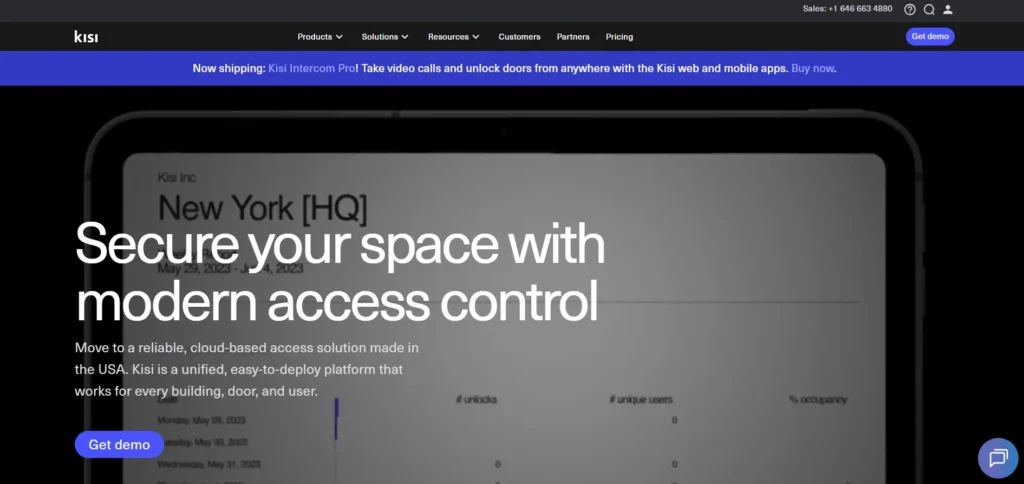
Kisi is an office access control system that runs on cloud technology and can be used to automate secure access to physical workspaces. Kisi also allows employees to open doors by swapping their smartphones, rather than by use of traditional keys or access cards, thus making it more modern and convenient to access a workplace. Entering permissions can be handled remotely by businesses, they can impose entry schedules and also track who is entering or leaving certain areas in real-time.
Kisi will be of particular use in expanding organizations that require scalable security solutions in various office sites. With the platform, administrators can grant or revoke access in real-time by using a simple dashboard that enables them to have centralized control. It is also compatible with other management services at the workplace that can assist organizations to streamline the operations in the facility.
Key Features
- Door access system based on mobile.
- of entry and exit real time.
- Remote accessing time controls.
- Security dashboard, which is managed by a cloud.
- Workplace integrations.
Best For
- Most suitable to companies that desire to automate their employees in terms of office access and secure areas.
- Fits well to organizations operating in multiple offices with advanced security requirements.
Website: https://www.getkisi.com/
Pricing:
- Start: $99/ month
- Enterprise: Contact kisi
2. Workable
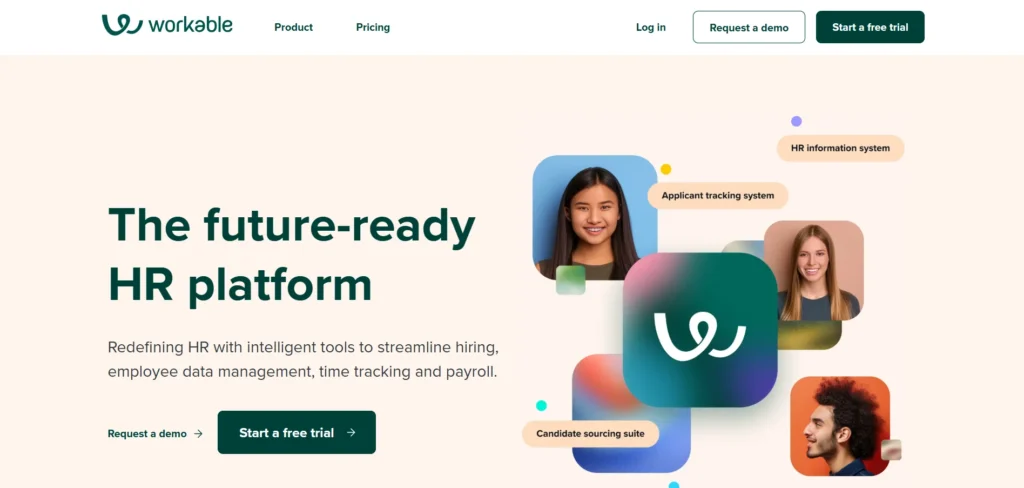
Workable is a staffing and employment automation service, which was created to make the whole talent acquisition process easier. It assists the HR departments to handle job advertisements, interviewing, and communicating with applicants effectively. Workable minimizes repetitive processes in recruitment by automating email replies, interviewing processes, authorizations, and onboarding processes.
The site has a customizability of job description, assessment and candidate scorecard, the hiring process becomes quicker and more organized. Hiring managers are able to go through applications and make feedback effortlessly with calendar syncing and collaboration tools. Workable has also features of building branded careers pages and posting jobs across various channels through the same dashboard.
Key Features
- Scheduling of interviews automatically.
- CW scorecards candidate evaluation.
- The job posting and careers page tools.
- Hiring automation through workflow.
- The email templates and communication tools.
Best For
- Ideal in cases where the company wants to automate the recruitment and hiring processes.
- Perfect when an HR team needs to hire many people on a regular basis.
Website: https://www.workable.com/
Pricing:
- Standard: $299/ month
- Premier: $599/ month
3. Jotform
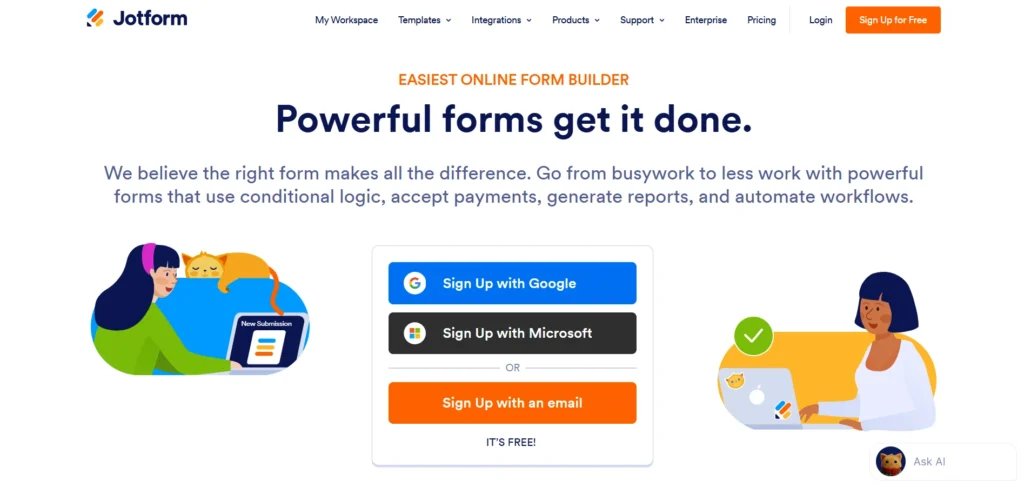
Jotform is an influential no-code automation platform that assists the companies in simplifying the approval process, submitting forms, working with documents, and collecting data. It enables users to create customizable forms, applications and automated approval procedures without technical knowledge. In the case of drag-and-drop tools, it is straightforward to construct a survey, registration form, employee request, and customer onboarding workflow by the organization.
Jotform also promotes automatic alerts and signature gathering, creating PDF files, and real-time reporting, which ensures that it is the best platform when it comes to minimizing paperwork and manual follow-ups. Data provided is automatically sorted in Jotform Tables and assists teams to manage records effectively. It is a worthy office automation tools that can be used in the daily routines of its flexibility and usability.
Key Features
- Drag and drop form and app builder.
- Routine approval procedures.
- Creation of digital signature and PDF.
- Jotform Tables Data management.
- Connections to 240 and more business applications.
Best For
- Ideal in automating approvals, forms and document-based processes.
- Perfect when a company is seeking daily office automation, no-code.
Website: https://www.jotform.com/
Pricing:
- Starter: free
- Bronze: $34/ month
- Silver: $39/ month
- Gold: $99/ month
- Enterprise: Custom pricing
4. Zapier
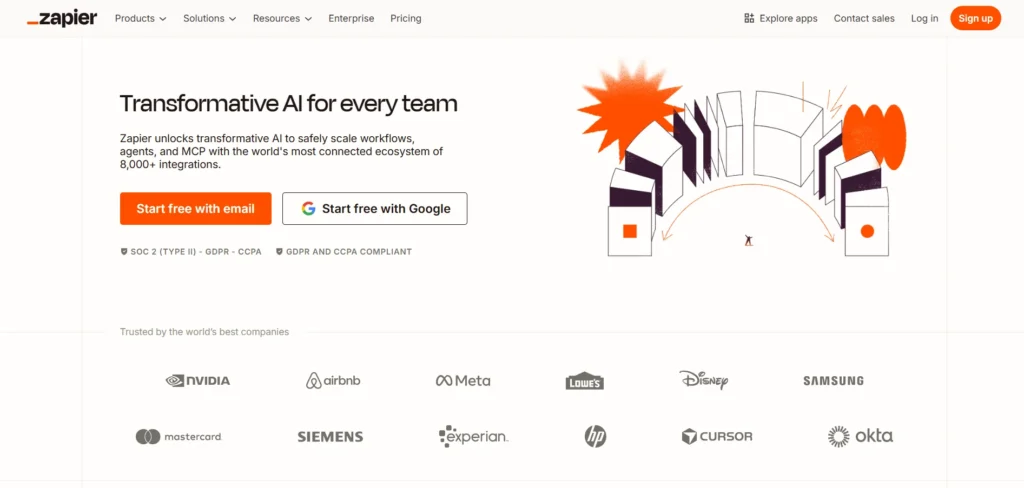
Zapier is among the most used third party automation tools to integrate third party applications and build automatic workflows, making it a key solution within Office Automation Tools. It allows companies to create integrations that are known as Zaps and cause action within one software platform to another without the need to code. To give an example, Zapier has the ability to automatically store email attachments in cloud storage, refresh CRM contacts, send Slack notifications, or create tasks in a project management system.
Zapier supports more than 5,000 applications, and it assists in removing manual repetition in marketing, human resources, financial services, and operations departments. Its drag-and-drop workflow builder enables users to generate a multi-step automation, which contains conditional logic, templates, and AI-enhanced features. Zapier would be best suited to the company that uses various tools and requires them to integrate with one another.
Key Features
- No-code workflow automation developer.
- Integrates with 5,000+ apps
- Automation (trigger/actions) Multi-step.
- Artificial intelligence workflow optimization.
- Template automation and logic Conditional logic.
Best For
- Best to automate workflow between different business applications.
- The best fit with the teams that do not code.
Website: https://zapier.com/
Pricing:
- Free: ₹ 0/ month
- Professional: ₹1865.18/ month
- Team: ₹6438/ month
- Enterprise: Custom pricing
5. Intruder

Intruder is a cybersecurity automation platform created to offer continuous vulnerability monitoring and threat detection to the businesses. Security risks are also becoming more complicated as organizations are turning to more digital systems and cloud infrastructure. Intruder automates security tests with the help of scanning networks, applications, and APIs to find vulnerabilities before attackers can use them.
The platform also performs ongoing vulnerability scans and prioritization of the results according to their severity, which allows IT teams to address the most urgent ones initially. Intruder is also used to identify the attack surface of an organization and gives elaborate audit reports and analytics to meet compliance needs. Threat detection can be performed automatically freeing businesses of manual security burdens and keeping them safe against new cyber threats.
Key Features
- This is done through continuous vulnerability scanning.
- Live threat monitoring board.
- Attack surface management tools refer to software designed specifically to address the issue of how the application is structured.
- Cyber hygiene marking scale.
Best For
- Most suitable in the cases when a company requires an automated system to monitor cybersecurity and detect vulnerabilities.
- Best suited to companies that handle cloud-based infrastructure and compliance requirements.
Website: https://www.intruder.io/
Pricing:
- Essential: $149/ month
- Cloud: $299/ month
- Pro: $499/ month
- Enterprise: Custom pricing
6. Procurify
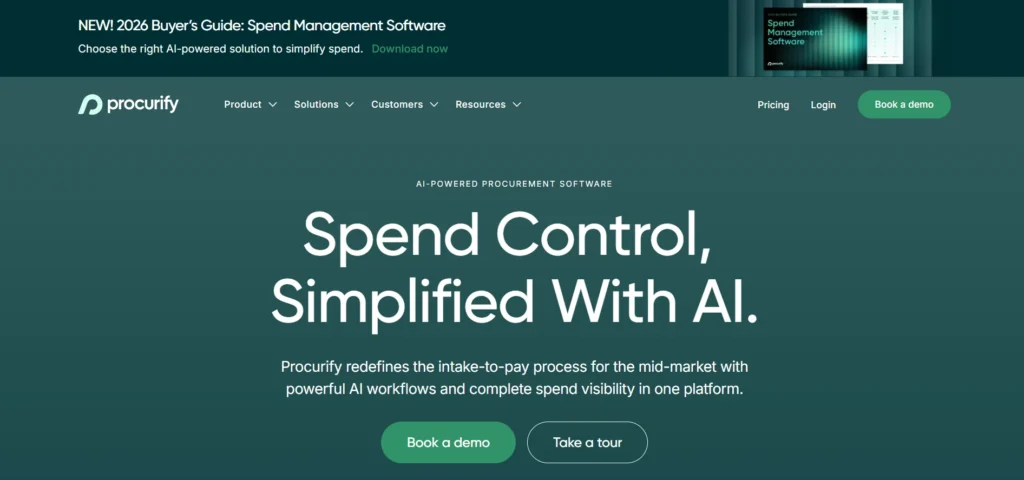
Procurify is an automated procurement and spend management software that is used to assist companies in managing their costs, budgets, and simplifying procurement processes. As part of modern Office Automation Tools, it enables companies to centralize buying operations, handle purchase requests, create purchase orders, and automate invoice processing. Real-time visibility of spend can enable finance departments to track money spent in the company in a better way and avoid unnecessary expenses.
Procurify also facilitates automated approval processes making sure that purchase requests pass through the right hands on time. The site is connected with accounting and ERP systems, which allows it to be easier to align the bills, vendor information, and financial data without entering this manually. Procurify is particularly useful in expanding businesses that would like to have a more advanced control over their spending and have their operations running quickly.
Key Features
- Real time spending monitoring and reporting.
- Automated order purchase management.
- Automation of invoice and bills manufacturing.
- Purchasing approval processes.
- ERP and accounting integration.
Best For
- Ideal in companies that require automated expenses tracking and purchasing control.
- Best suited to procurement management teams working with large amounts of finance.
Website: https://www.procurify.com/
Pricing:
- Custom pricing
7. Automation Anywhere
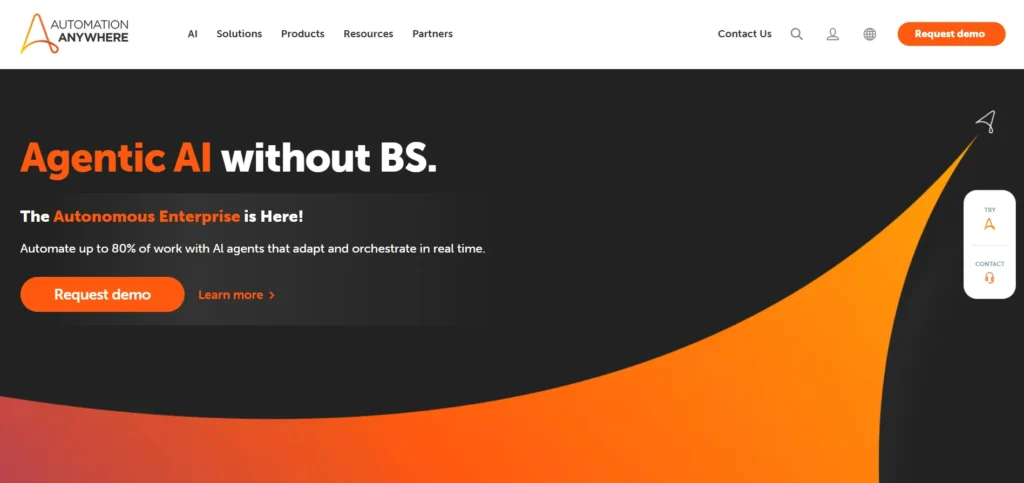
Automation Anywhere is one of the most popular robotic process automation (RPA) solutions and it enables companies to robotize routine and rule-driven work with software bots. It also allows organizations to develop intelligent automation processes that are driven by AI and machine learning so that bots can perform tasks that include data entry, file transfer, calculations, report creation, system monitoring, etc. It is a cloud-native platform that can be deployed to the public cloud, the private cloud, or a hybrid system, or on-premises.
Automation anywhere finds application in various industries like healthcare, manufacturing, finance, and IT where large volumes of processes need to be fast and accurate. Through automated bots 24/7 organizations are able to speed up workflows, reduce human error and allow employees to concentrate on more valuable strategic work as opposed to manual routine work.
Key Features
- Robot process automation bots that run with AI.
- Native automation platform in the clouds.
- Ready-made automation templates.
- Bonds with enterprise systems.
- Assists in multiple deployment.
Best For
- Best when there is repetition of large tasks and the use of software bots to automate the tasks.
Website: https://www.automationanywhere.com/
Pricing:
- Not available
8. LobbyGuard
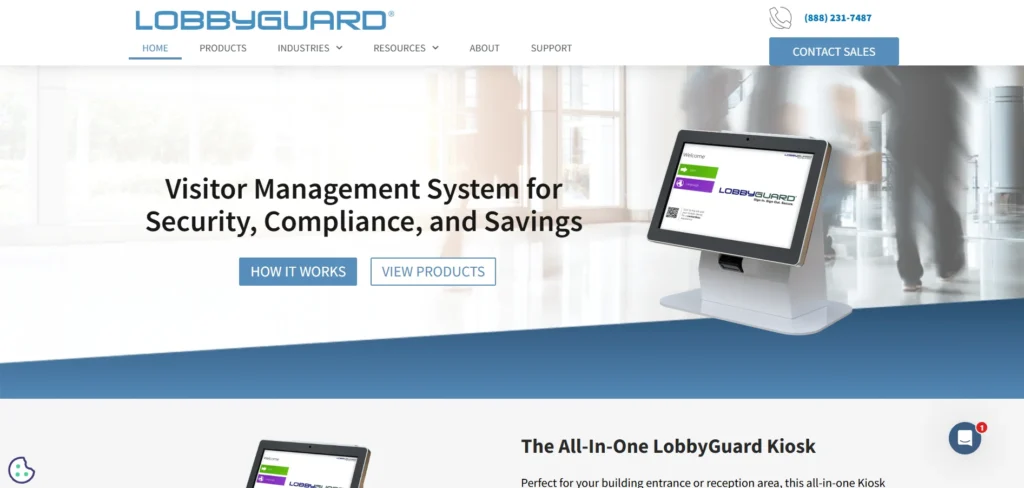
LobbyGuard is an automation visitor management software that aims at enhancing security in the workplace and simplifying the process of checking guests in. Instead of using the old paper logs on visitors, it will enable visitors who have signed in to be provided with badges and take all the necessary screening measures using a digital kiosk system.
LobbyGuard provides a contactless entry system, QR-code-based entry, and tailored processes of various visitor types. Companies can also establish red-flag and green-flag screening to single out unauthorized persons and can send real-time alerts to the employees. It is particularly applicable to offices, schools, medical facilities, and company buildings, where the safety and the efficient tracking of visitors require high security and organization.
Key Features
- Contactless visitor check-in kiosk.
- Check-in and badge printing QR check-in.
- Individual visitor screening processes.
- Emergency notification and alerts.
- Visitor reporting and compliance control.
Best For
- Most appropriate to work with visitor check-ins and workplace entry.
- Perfect fit in the facility security and compliance oriented organisations.
Website: https://lobbyguard.com/
Pricing:
- Free trail available
- pricing not available
9. Trello
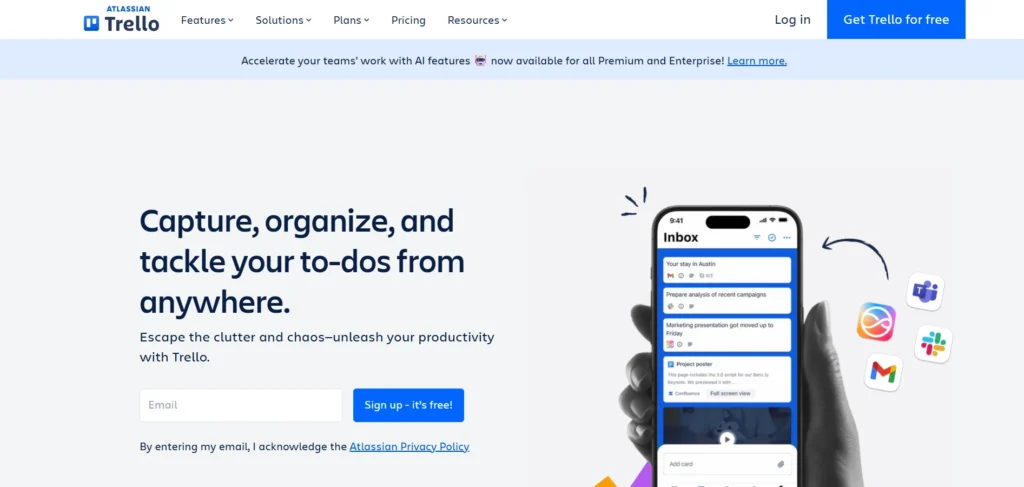
Trello is an example of a popular project and task management software that assists businesses in automating the structure of their workflows and collaborating in teams. Trello is created based on a board-and-card system and enables teams to handle tasks and allocate duties, follow the progress, and simplify communication in a single location.
It is popular in office productivity, planning of content, human resource and management of operational tasks. There is also automation in Trello in the form of Butler which enables the user to automate repetitive tasks in the form of moving cards, sending reminders, assigning tasks as well as updating due dates. Having integrations with such tools as Slack, Google Drive, Jira, and Microsoft Teams, Trello is a versatile office automation tools to use in everyday workflows.
Key Features
- Board of visual tasks and workflow monitoring.
- Butler automation of repetitive operations.
- Team work and delegation of duties.
- Workplace integrations.
- Workflows and templates can be customized.
Best For
- Most suitable in terms of automation of tasks management and team productivity.
- Perfect in those offices that require straightforward workflow organization tools.
Website: https://trello.com/
Pricing:
- Free: $0USD
- Standard: $5/ month
- Premium: $10/ month
- Enterprise: $17.50 / month
10. Microsoft Power Automate
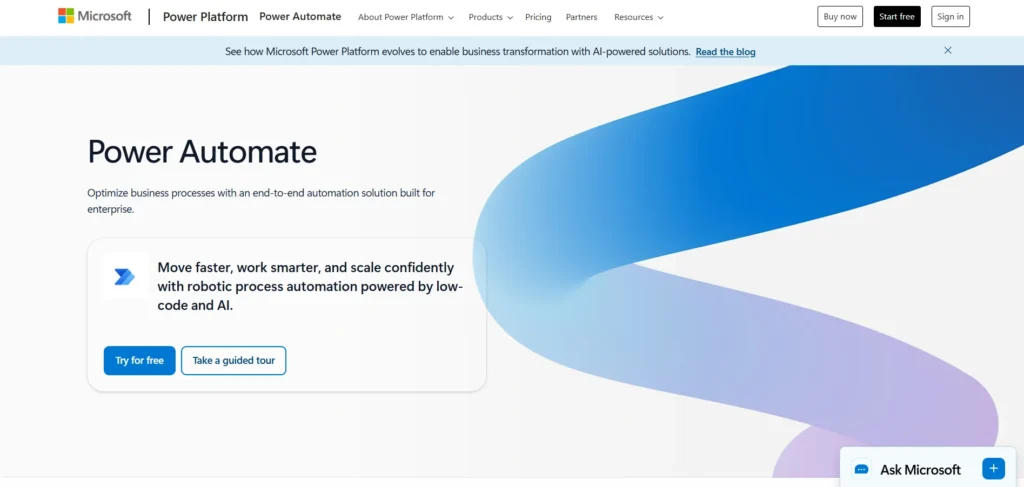
Microsoft power automate refers to a workflow automation service that enables companies to automate repetitive tasks on both Microsoft and third party applications. It enables users to generate automated processes that can process activities like dispatching notifications, gathering approvals, synchronizations of data and creating reports without the need to do it manually. Power Automate is built with a close relationship with Microsoft 365 applications such as outlook, teams, SharePoint, Excel, and Dynamics 365 and can be easily integrated by companies who have already adopted the Microsoft ecosystem.
The system has no-code automation templates as well as complex business needs with advanced custom workflows. Power Automate has the ability to automate document processing, form processing and tasks of a legacy system with AI Builder and robotic process automation capabilities.
Key Features
- No-code templates Workflow automation.
- Intensive connection to MS 365 applications.
- Automation of approval and notifications.
- Robotic Processing and Artificial intelligence capabilities.
- Allows third party application integration.
Best For
- Better in automating processes in Office environments based on Microsoft.
- Perfect to a company that needs scalable process automation solutions.
Website: https://www.microsoft.com/en-us/power-platform/products/power-automate/
Pricing:
- Start: free
- Power Automate Premium: $15/ month.
- Power Automate Process:$150/ month.
- Power Automate hosted Process:$215/ month.
Comparison Table of Office Automation Tools
| Tool | Pros | Cons | Pricing |
| Kisi | Mobile access, secure | Hardware needed | From $99/month |
| Workable | Fast hiring automation | Costly for small teams | From $299/month |
| Jotform | No-code, easy to use | Multi-user limits | Free, $99/month |
| Zapier | 5,000+ integrations | Task limits | Free, ₹6,438/month |
| Intruder | Strong cybersecurity | No free plan | From $149/month |
| Procurify | Expense control | Custom pricing only | Custom |
| Automation Anywhere | Powerful RPA | Complex setup | Not disclosed |
| LobbyGuard | Secure visitor check-in | Hardware required | Custom |
| Trello | Simple task automation | Limited reporting | Free, $17.50/month |
| Microsoft Power Automate | Microsoft integration | Premium add-ons | Free, $215/month |
Conclusion
Office automation tools have become essential for modern businesses looking to improve productivity, reduce manual workload, and streamline daily operations. From task management and recruitment to cybersecurity and expense tracking, these tools help organizations save time, minimize errors, and create smoother workflows. By adopting the right automation solutions, businesses can enhance efficiency, support collaboration, and focus more on strategic growth in 2026 and beyond.
FAQs
What are Office Automation Tools?
They are software solutions that automate repetitive office tasks to improve efficiency and productivity.
Why Should Businesses use Office Automation Software?
It helps save time, reduce errors, and streamline workflows across departments.
Which Office Automation Tool is Best for Workflow Integration?
Zapier is widely used for connecting multiple apps and automating workflows easily.
Are Office Automation Tools Suitable for Small Businesses?
Yes, many tools offer affordable and scalable plans for startups and small teams.
What is the Future Trend in Office Automation?
AI-powered automation and hyperautomation are shaping the future of smarter workplaces.