Flipkart is an integral part of the e-commerce story in India. It all began with an online bookstore in a small apartment in Bengaluru in 2007 and is now one of the most formidable digital markets in Asia. In 2026, Flipkart is in an unprecedented position in the Indian retail space — and knowing about its strategic DNA becomes even more relevant today.
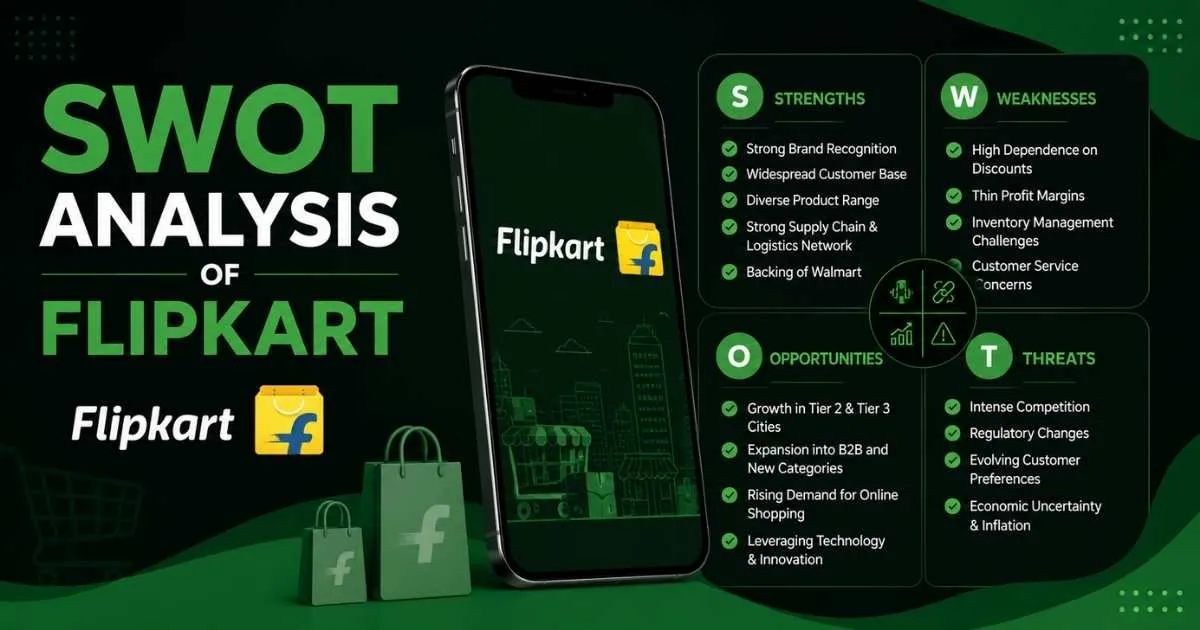
This is a comprehensive SWOT analysis of Flipkart that helps us understand the all-round strengths and weaknesses of this giant, the opportunities it can tap into, and the very real threats it has to navigate. Flipkart has made it to the second position in the Hurun India Unlisted Gems 2026 list with ₹83,105 crore of revenues, a dramatic rise from its previous rank. In this article, we’ll take it all apart for you — step-by-step and in detail!
Flipkart – Company Overview
Flipkart is the biggest e-commerce marketplace in India, established in 2007 by Sachin Bansal and Binny Bansal in the city of Bengaluru. Acquired by Walmart in 2018, it has grown from a modest online bookstore into a comprehensive digital retail powerhouse touching nearly every product category imaginable.
| Company Detail | Information |
|---|---|
| Founded | 2007 |
| Headquarters | Bengaluru, India |
| CEO | Kalyan Krishnamurthy |
| Parent Company | Walmart (~85% stake) |
| Revenue (FY2025) | ₹82,787 crore (~$9.8B) |
| Market Share | ~32% of India’s e-commerce market |
| Monthly Active Users | 220–240 million |
| Key Subsidiaries | Myntra, Ekart, Cleartrip, Shopsy |
What started as a two-person operation delivering books has scaled into a platform that lists over 80 million products across 80+ categories — from smartphones and fashion to groceries and furniture. That transformation makes Flipkart’s business journey one of the most studied cases in Indian startup history.
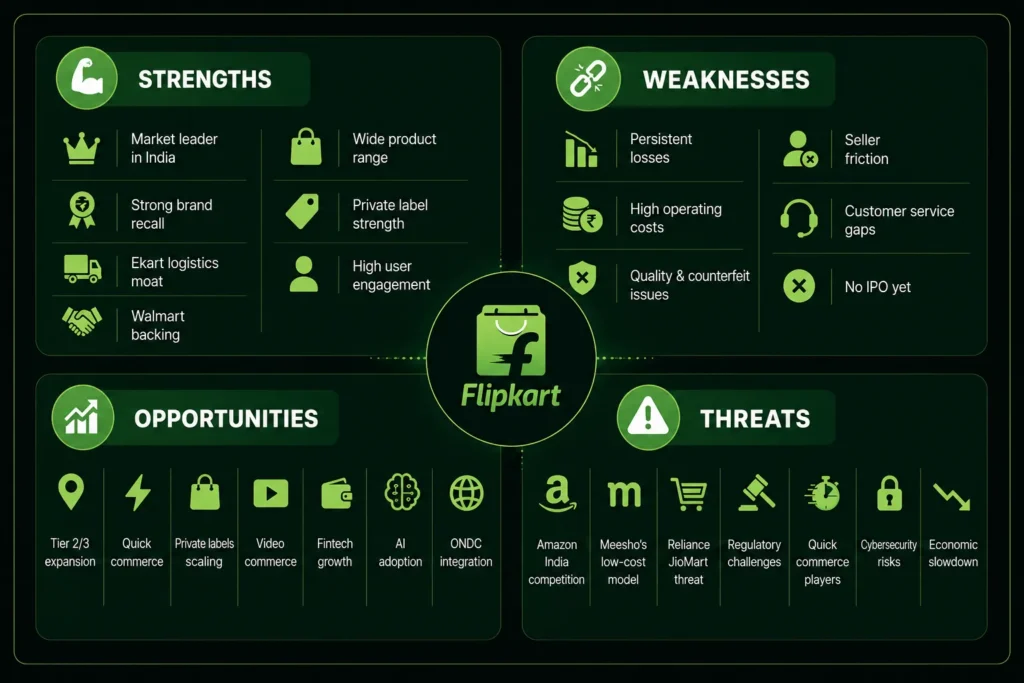
SWOT Analysis of Flipkart – Summary Table
| SWOT Factor | Key Points |
|---|---|
| Strengths | Market leadership, Walmart backing, Ekart logistics, strong brand recall, diverse category depth |
| Weaknesses | Persistent losses, high operational costs, seller commission disputes, counterfeit product issues |
| Opportunities | Tier 2 & 3 city expansion, quick commerce entry, rising smartphone penetration, rural India |
| Threats | Amazon & Meesho competition, regulatory pressure, cybersecurity risks, JioMart’s rise |
Also Read: Flipkart Subsidiaries
1. Flipkart Strengths
The SWOT analysis of Flipkart begins where it should — with the engine behind its continued dominance in India’s e-commerce industry for nearly 19 years. Flipkart commands a 220–240 million monthly active user base and is estimated to hold a 50–60% share of India’s e-commerce GMV (including Myntra). In consumer electronics and appliances alone, Flipkart holds a commanding 63–64% market share. These aren’t just numbers — they are a testament to consumer trust and the strongest operational foundation any Indian e-commerce platform has ever built.
Brand Equity and First-Mover Advantage
Flipkart is not just a brand — it is synonymous with online shopping for a significant portion of Indian consumers. Since 2007, it has been a consistent game-changer, from introducing Cash on Delivery (CoD) when digital payments were virtually non-existent in India, to pioneering Big Billion Days — one of the most anticipated sale events in the country. This first-mover advantage has created deep behavioral loyalty, particularly among middle-income and value-seeking Indian shoppers.
Ekart Logistics – The In-House Supply Chain Moat
Ekart Logistics, Flipkart’s wholly-owned supply chain arm, is one of the most underrated competitive moats in Indian e-commerce. Operating over 1,000 delivery hubs and serving 800+ cities, Ekart enables Flipkart to control delivery speed, quality, and cost without being at the mercy of third-party couriers. This end-to-end logistics ownership directly translates into faster deliveries, reduced RTO (Return to Origin) rates, and better last-mile customer experience — all of which are critical competitive levers.
Walmart Backing – Strategic, Financial, and Operational
When Walmart acquired a majority stake in 2018 for approximately $16 billion, it was the largest e-commerce acquisition in history at the time. In 2026, this relationship remains Flipkart’s most powerful strategic asset. Walmart brings:
- Deep-pocket financial backing, allowing Flipkart to continue investing in infrastructure and growth without immediate profitability pressure
- Global supply chain expertise, helping Flipkart optimise its warehousing, procurement, and vendor management operations
- Omnichannel retail know-how, guiding Flipkart’s potential offline or hybrid retail ambitions
- International credibility, making Flipkart attractive to global brands seeking an Indian distribution partner
Massive Product Depth and Category Leadership
With more than 80 million product listings across 80+ categories, Flipkart meets the broadest possible spectrum of Indian consumer needs. Its dominance in smartphones, large appliances, and fashion (via Myntra) means it captures spending across life stages — from college students buying their first smartphone to families upgrading home appliances.
Private Labels and Exclusive Brand Partnerships
Flipkart SmartBuy and MarQ (its appliance private label) are growing contributors to margins. Private labels give Flipkart pricing flexibility, higher margin retention, and product differentiation that marketplace-only players simply cannot replicate. Exclusive launch partnerships with brands like Motorola, Xiaomi, and Samsung for India-first product releases drive traffic spikes and reinforce Flipkart’s positioning as the preferred destination for electronics.
Rising User Engagement Metrics
In early 2026, Flipkart gained 26.8 million weekly active users — more than double the 10.6 million gained collectively by all other competitors. This engagement gap is not accidental. It reflects years of investment in personalized recommendations, SuperCoins loyalty rewards, Flipkart Plus memberships, and a mobile-first UX that resonates with India’s predominantly smartphone-driven internet users.
2. Flipkart Weaknesses
There is no SWOT analysis of Flipkart without confronting its weaknesses head-on. Impressive as the scale is, Flipkart is still loss-making. In FY2025, Flipkart’s net loss stood at ₹5,189 crore, raising persistent questions about its profitability trajectory. High operating expenses, thin margins, and recurring quality concerns continue to weigh on its long-term financial narrative.
Persistent Losses Despite Scale
Flipkart’s revenue touching ₹82,000+ crore is remarkable — but the inability to convert that scale into sustained profit is a structural weakness. The business model relies heavily on deep discounting during sale events, aggressive customer acquisition spending, and massive logistics infrastructure investment. While these are necessary for market share defense, they keep the bottom line firmly in the red.
High Operational and Customer Acquisition Costs
Running a platform of Flipkart’s size is extraordinarily expensive. Warehousing costs across hundreds of fulfilment centres, technology infrastructure maintenance, Ekart’s fleet operations, marketing spends (particularly around Big Billion Days), and seller support systems together create a cost structure that compresses margins significantly. As competitors like Meesho operate on lean, asset-light models, Flipkart’s heavier infrastructure becomes a relative disadvantage.
Counterfeit and Quality Control Issues
The problem of counterfeit and low-quality products on Flipkart has been a recurring concern. Nicknames like “Flopkart” or “Fakekart” — though used loosely — reflect genuine consumer frustration. In a marketplace model where millions of third-party sellers list products, ensuring product authenticity at scale is a massive operational challenge. This issue directly erodes consumer trust, increases return rates, and ultimately affects Flipkart’s Net Promoter Score (NPS).
Seller Commission and Ecosystem Friction
Flipkart charges seller commissions of up to 25% per sale, which is a significant economic burden for small and medium sellers. Coupled with occasional allegations of preferential treatment for large sellers or Flipkart’s own private label products, there is a perceived lack of a level playing field.
Customer Service Inconsistency
Despite years of investment, Flipkart’s customer service remains a pain point for a segment of its users. Delayed refunds, difficult return processes for certain product categories, and inconsistent resolution times — particularly during high-traffic sale periods — directly impact repeat purchase rates. In an era where consumer expectations for service speed are set by global benchmarks, this is an area that demands urgent investment.
Delayed IPO Timeline
Walmart has opted to hold back on Flipkart’s IPO until the company achieves a clearer path to profitability. This delayed public listing is both a symptom of the profitability challenge and a constraint in itself — limiting Flipkart’s ability to offer ESOPs as aggressively, attract top talent seeking liquid equity, and generate the public market validation that could accelerate brand partnerships.
3. Flipkart Opportunities
The SWOT analysis of Flipkart reveals a landscape absolutely rich with opportunities. By 2026, India is fast becoming a digital-first economy with hundreds of millions of first-time internet users, a rapidly growing middle class, and a government actively pushing digital payments and rural connectivity. Flipkart, given its scale and infrastructure, is better positioned than almost anyone to capture this wave.
Tier 2 & Tier 3 City Expansion
The next phase of Indian e-commerce growth will not come from metros — it will come from Bharat. Cities like Patna, Coimbatore, Surat, Indore, and thousands of smaller towns are seeing explosive growth in digital adoption. Millions of new online shoppers are entering these markets for the first time, predominantly on smartphones, and with rising disposable incomes. Flipkart’s Shopsy platform — a social commerce and reseller app — is already designed to tap into this segment.
Quick Commerce – A High-Stakes Opportunity
India’s quick commerce segment is already generating $5 billion+ in annual GMV in 2026, with platforms like Blinkit, Zepto, and Swiggy Instamart dominating 10–30 minute deliveries. Flipkart has the logistics infrastructure through Ekart and the consumer reach to make a serious play in this space. A focused quick commerce initiative — perhaps via dark stores integrated with existing Ekart hubs — could allow Flipkart to compete for the high-frequency, high-retention grocery and daily essentials basket.
Private Label Scaling
Flipkart SmartBuy and MarQ are already established, but the private label opportunity is significantly under-exploited. Categories like personal care, home essentials, kitchen appliances, and affordable fashion are ripe for private label expansion. Higher-margin private labels directly improve the unit economics of each transaction, bringing Flipkart closer to profitability without requiring incremental revenue growth.
Video Commerce and Content-Led Discovery
The fusion of entertainment and shopping — popularised in China by platforms like Douyin — is arriving in India. Short-form video content is now the primary mode of product discovery for younger Indian consumers. Flipkart has the user base to create a compelling video commerce layer. Live shopping events, influencer-led product demos, and shoppable video content can significantly increase time-on-platform and conversion rates, especially in fashion, beauty, and electronics categories.
Fintech and Financial Services Expansion
Flipkart’s SuperCoin rewards ecosystem, EMI financing tie-ups, and its access to transaction data across 220+ million users create a natural launchpad for financial services. Buy Now Pay Later (BNPL), micro-insurance, co-branded credit cards, and SME lending to its seller ecosystem are all high-margin, high-stickiness opportunities that global e-commerce platforms have successfully monetised.
AI-Driven Personalisation and Operational Efficiency
Investment in AI and machine learning can drive two parallel benefits for Flipkart. On the consumer side, hyper-personalised recommendations, dynamic pricing, and AI-powered search can increase conversion rates and average order values. On the operational side, AI-driven demand forecasting, warehouse automation, and intelligent routing for Ekart can meaningfully reduce logistics costs. Both levers move the needle on profitability — the metric Flipkart needs most.
Rural Commerce via ONDC Integration
The Open Network for Digital Commerce (ONDC) is India’s government-backed open protocol aimed at democratising e-commerce. While ONDC is still evolving, Flipkart’s early participation can give it access to new seller ecosystems, rural distribution networks, and government visibility. Being an active player in ONDC positions Flipkart well in the event of regulatory mandates pushing e-commerce giants toward open-network participation.
4. Flipkart Threats
The SWOT analysis of Flipkart would be incomplete without examining the threats — which are very real, very active, and growing more formidable each year. India’s e-commerce sector is one of the most competitively intense markets globally, and Flipkart cannot afford complacency.
Amazon India – A Relentless Competitor
Amazon India remains Flipkart’s most dangerous direct competitor, commanding approximately 26–28% of India’s e-commerce GMV. Amazon’s strengths are concentrated in the premium consumer segment — high-income urban buyers who value delivery reliability, Prime Video bundling, and global brand access. Amazon’s deep investment in Amazon Prime, AWS (which funds aggressive discounting), and its B2B marketplace (Amazon Business) makes it a multi-dimensional threat.
Rise of Meesho – The Value Commerce Disruptor
Meesho is arguably the most disruptive force in Indian e-commerce right now. By targeting price-sensitive consumers in Tier 2, 3, and 4 cities with ultra-low-cost products and zero commission for sellers, Meesho has carved out a massive and fast-growing niche. This is precisely Flipkart’s core customer base — and Meesho is eating into it. With reportedly 140+ million transacting users and a lean cost structure, Meesho is a structurally difficult competitor for Flipkart to fight on price alone.
JioMart and Reliance Retail – The Omnichannel Threat
Reliance Retail’s JioMart platform, backed by India’s largest telecom network (Jio), its vast physical retail presence (Reliance Fresh, Smart Bazaar, Trends), and Mukesh Ambani’s virtually unlimited capital, is a unique and growing threat. JioMart’s ability to offer a seamless online-to-offline (O2O) shopping experience — where consumers order online and pick up from a nearby Reliance store — is a model Flipkart currently has no direct answer to. In groceries, fashion, and electronics, Reliance is building genuine momentum.
Regulatory and Compliance Pressures
India’s e-commerce regulatory landscape is evolving fast — and not always in ways that benefit large marketplaces. Key regulatory risks for Flipkart include:
- FDI restrictions limiting deep discounting practices by marketplace entities with foreign ownership
- Tax Collected at Source (TCS) requirements increasing working capital burden for sellers
- Consumer Protection (E-Commerce) Rules, which impose stricter obligations around product liability, grievance redressal, and dark pattern prevention
- Data localisation mandates under India’s Digital Personal Data Protection Act (DPDPA), requiring significant technology infrastructure investment
Each of these creates compliance costs, operational friction, and potential revenue impact.
Cybersecurity and Data Privacy Risks
Flipkart processes hundreds of millions of transactions annually and holds sensitive personal, financial, and behavioural data on over 220 million users. This makes it an extremely high-value target for cybercriminals, state-sponsored hackers, and fraudsters. A major data breach — of the kind that has damaged trust at global platforms — would be catastrophic for Flipkart’s consumer confidence, regulatory standing, and brand equity. As India’s DPDPA enforcement ramps up, the consequences of data breaches are also becoming legally severe.
Quick Commerce Cannibalisation
The explosive growth of Blinkit, Zepto, and Swiggy Instamart is not just a competitive threat in a new category — it is actively cannibalising Flipkart’s grocery and daily essentials GMV. As consumers shift to 10-minute delivery for daily needs, the “weekly big shop” on Flipkart loses relevance. If Flipkart doesn’t build a credible quick commerce offering soon, it risks losing the most habit-forming category in e-commerce.
Economic Slowdown and Consumer Sentiment
India’s macroeconomic environment, while resilient, is not immune to global headwinds. Interest rate pressures, rural income volatility, and urban unemployment can all compress discretionary consumer spending. Flipkart’s revenue heavily depends on big-ticket purchases in electronics and appliances — categories that are the first to be deferred when household budgets tighten. Economic uncertainty is a structural threat to Flipkart’s top-line growth trajectory.
Flipkart vs Amazon India – Detailed SWOT Comparison
| Parameter | Flipkart | Amazon India |
|---|---|---|
| Market Share (GMV) | ~50–60% (incl. Myntra) | ~26–28% |
| Electronics Market Share | 63–64% | Strong in premium segment |
| Parent Company | Walmart (~85%) | Amazon Inc. (USA) |
| Logistics | Ekart (in-house) | Amazon Logistics (in-house) |
| Strengths | India-first approach, price-sensitive audience, Big Billion Days | Global brand trust, Prime ecosystem, AWS funding |
| Weaknesses | Continued losses, counterfeit product issues | Regulatory scrutiny, weaker Tier 3 penetration |
| Opportunities | Tier 2/3 cities, quick commerce, fintech | Premium segment growth, B2B expansion |
| Threats | Meesho, JioMart, regulatory changes | Flipkart’s dominance, FDI restrictions |
| Key Sale Event | Big Billion Days | Great Indian Festival |
| Monthly Active Users | 220–240 million | ~150–180 million (est.) |
| Profitability | Loss-making | Loss-making in India operations |
| Private Labels | Flipkart SmartBuy, MarQ | Amazon Basics, Solimo |
Flipkart’s Strategic Outlook: What 2026 and Beyond Holds
Reading the SWOT analysis holistically, Flipkart’s strategic priorities for sustained relevance and eventual profitability come into sharp focus:
1. Accelerate the path to profitability. Walmart’s patience has limits. Flipkart must demonstrate a credible unit economics story — higher private label mix, reduced dependency on deep discounting, and operational leverage from Ekart are the most viable levers.
2. Double down on Bharat. Meesho’s rise is a direct warning. Flipkart’s Shopsy must evolve from a side experiment into a fully-committed Bharat commerce platform with localised assortments, vernacular language support, and agent-assisted commerce for low-digital-literacy users.
3. Build a quick commerce identity. The 10-minute delivery war is already being lost to Blinkit and Zepto. Flipkart needs to stake its ground — either through Ekart-powered dark stores or strategic acquisition — before the grocery habit is irreversibly ceded.
4. Resolve seller ecosystem health. Flipkart’s long-term marketplace strength depends on a thriving, diverse seller base. Reducing commission friction, improving payment cycles, and creating transparent ranking policies can rebuild seller trust and listing quality simultaneously.
5. Invest in AI as a margin lever. Not just as a consumer-facing feature, but as an operational efficiency engine — demand forecasting, automated warehouse management, intelligent return processing, and fraud detection. Each percentage point of logistics cost reduction translates to hundreds of crore in bottom-line improvement at Flipkart’s scale.
Conclusion
Overall, the SWOT analysis of Flipkart 2026 shows a company that has a lot going for it, with a strong presence in the e-commerce market, a loyal customer base, and the capacity to expand and earn a larger share of the market. Flipkart is the leader in the Indian e-commerce space with more than 220 million of monthly active users and a commanding market in almost all categories. Walmart’s support provides not only financial backing but also brings a wealth of experience and long-term strategic vision to the table.
But the path ahead requires greater focus on profitability, on improving the relationship with sellers and an impassioned approach to new growth regions such as quick commerce and rural areas. The SWOT analysis of Flipkart clearly suggests that the best is yet to come if Flipkart can make its big size profitable in terms of sustainable margins and double its customer confidence. Flipkart is not limited to a business, it’s the backbone of ecommerce in India and that’s a fact.
FAQ
What are the major strengths of Flipkart?
Flipkart’s strengths are its market-leading e-commerce position in India, Walmart’s financial and strategic support, the company’s own logistics arm, Ekart, its 80+ product categories, and its fast-expanding monthly active user base of 220–240 million.
What’s the reason behind Flipkart’s losses in the face of high revenue?
Flipkart makes little profit in its business. The investments in the logistics infrastructure, warehousing, technology, deep discounts during sale events and high marketing spend are always in excess of the revenue generated and profitability is a long-term objective and not a reality.
How does Walmart’s ownership benefit Flipkart?
Flipkart became a part of Walmart’s fold in 2018, opening up huge capital reserves, an expertise in supply chain and credibility on the international scene. It also gives the investment a safety net in that it can continue to invest in growth rather than the pressure of immediate returns that a public listing would impose.
What are the biggest threats to Flipkart in 2026?
Amazon India’s aggressive push and the emergence of growth-minded start-ups like Meesho pose the most significant challenges, as do the regulatory and compliance demands, cybersecurity risks, and the proliferation of speed commerce providers such as Blinkit and Zepto, which are taking market share from the company.
What are the areas of improvement for Flipkart?
To overcome its challenges, Flipkart can reduce its commissions for the sellers to attract small businesses, invest more on AI-driven counterfeit detection, invest in better customer service resolution systems to make it faster, increase quick commerce initiatives, and gradually focus more on high-margin private label products to become profitable.